


 Optical Transceiver
 DAC/AOC Cable
 Fiber Cabling
 Networking
Blog, Networking Device
VLAN vs VXLAN: What Are The Differences?
Jun
In today’s world, networks are essential. In light of increased network size, there is a need for increased isolation capability and scalability. VLAN technology was designed and implemented to fulfill these requirements. After that, VXLAN technology came and succeeded in overcoming the limitations in terms of scalability of conventional networks. It was possible for VXLAN to deploy itself flexibly in different kinds of networks. This blog highlights both technologies and gives a VLAN vs VXLAN comparison.
Table of contents
What is a VLAN
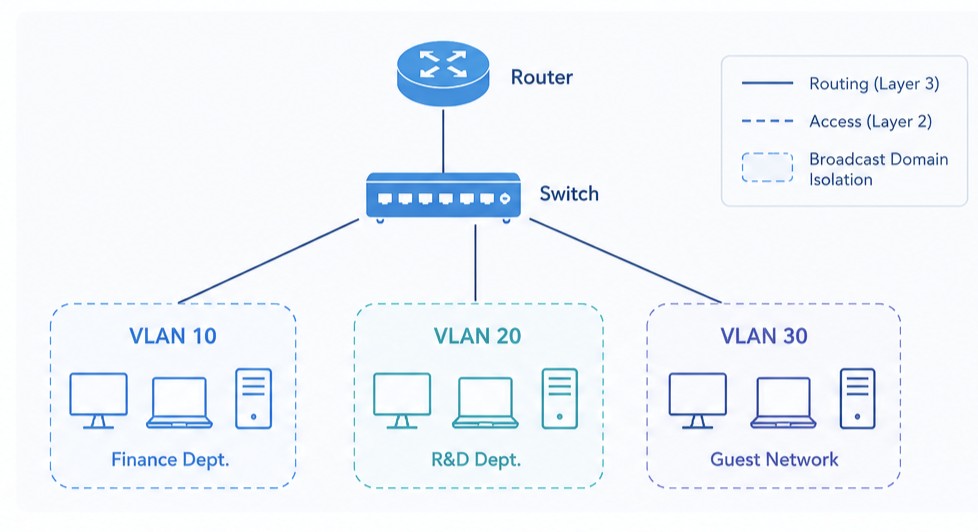
A VLAN, or Virtual Local Area Network, refers to a technique used for network segmentation through the use of switches. A VLAN is created at Layer 2 of the OSI model, the Data Link layer. Normally, in a conventional LAN, devices attached to the same switch are in the same broadcast domain, and broadcast data packets are flooded across all ports. In this case, many broadcasts within the network may affect network performance. VLANs allow the creation of several logical networks on the switch and the segregation of devices within the same physical network.
For instance, computers in the finance department may belong to VLAN 10, computers in the research and development (R&D) department to VLAN 20, and computers in the guest VLAN to VLAN 30. By default, packets in one VLAN cannot communicate with those in another VLAN, ensuring traffic isolation.
VLAN Advantages
- Network segmentation does not require additional switch deployment to reduce infrastructure costs.
- Separate departments and services are isolated from one another, simplifying network administration.
- The broadcast traffic will remain within its respective VLAN, minimizing unnecessary network congestion.
- Increased isolation will be attained since devices on separate VLANs cannot communicate with one another by default.
Why VLAN Is No Longer Enough
VLAN achieved great success in traditional networks. However, with the growth of virtualization and cloud computing, several limitations have become more obvious. The VLAN ID field is only 12 bits long, which means a network can support up to 4,094 VLANs. This was more than enough for most enterprises in the past, but modern large-scale data centers can easily exceed this number.
In addition, VLAN mainly relies on Layer 2 network infrastructure. When services need to move across switches, server racks, buildings, or even different data centers, VLAN extension becomes increasingly complex. To overcome these limitations, the industry started looking for a technology that could continue to provide Layer 2 network services while operating across a Layer 3 IP network. This led to the development of VXLAN.
What is VXLAN
VXLAN (Virtual Extensible Local Area Network) is an Overlay networking technology. VXLAN was originally introduced by companies such as VMware, Cisco, and Arista, and later became an IETF standard. Its main goal is to build a scalable virtual Layer 2 network on top of an existing IP network, solving the scalability challenges of traditional VLANs in cloud computing environments and large-scale data centers.
VLAN vs. VXLAN: VXLAN enables the establishment of logical links between servers over the existing Layer 3 IP network. In contrast to traditional VLAN implementations that may require extending the Layer 2 network across multiple switches, VXLAN technology enables servers to continue operating as if they were connected to the same local network while their traffic is encapsulated within the IP network.
VXLAN operates on the principle of putting the initial frame into UDP packets. Upon entering the network, the VXLAN header is applied to the initial packet. It consists of the VNI (VXLAN Network Identifier), which helps separate virtual networks from one another. Classical VLAN technology can support up to 4,094 virtual networks, whereas VXLAN supports more than 16 million.
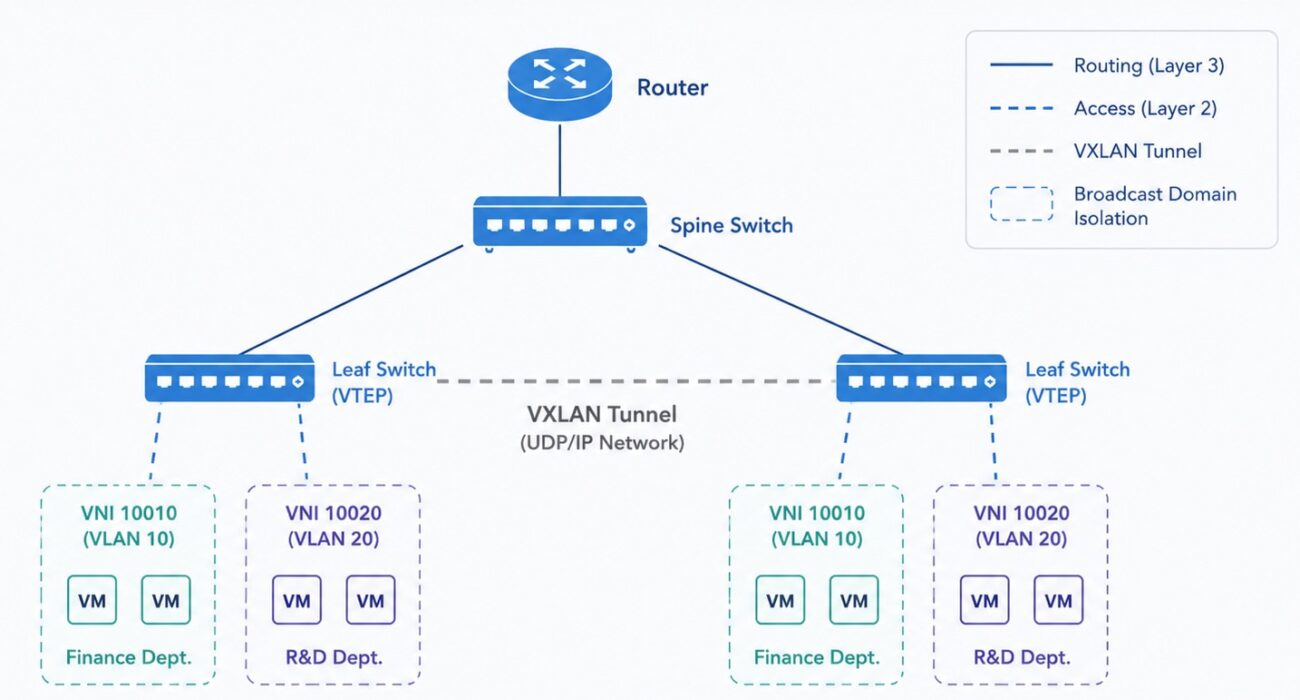
Key Features of VXLAN
- Scalability in VXLAN is increased by expanding the number of available virtual networks from 4,094 VLANs to over 16 million VNIs.
- VXLAN provides scalability by carrying Layer 2 traffic over Layer 3 packets, allowing networks to span beyond a single physical switch or rack.
- VMs and Containers can still exist on the same network even when physically separated.
- Multitenant networking is improved with better network segregation without requiring many VLAN IDs.
VLAN vs VXLAN: What Are The Differences?
| Comparison | VLAN | VXLAN |
|---|---|---|
| OSI Layer | Layer 2 | Overlay over Layer 3 |
| Network Identifier | VLAN ID | VNI |
| Identifier Length | 12-bit | 24-bit |
| Maximum Networks | 4,094 | Over 16 Million |
| Encapsulation | IEEE 802.1Q Tag | UDP Encapsulation |
| Cross-Subnet Extension | Difficult | Easy |
| Multi-Tenant Support | Limited | Excellent |
The biggest difference between VLAN and VXLAN is scalability. The number of available networks increases from 4,094 to more than 16 million. By carrying Layer 2 traffic across a Layer 3 IP network, data centers no longer need to build large Layer 2 domains to support services.
Network administrators can maintain a stable IP infrastructure while creating independent virtual networks for individual tenants, applications, or business systems. This allows the network to continue growing as the data center expands without being limited by the underlying architecture.
How VLAN and VXLAN Work Together
It is worth noting that VLAN and VXLAN are often used together in data center networks to ensure effective network isolation. Thus, VLAN is responsible for separating business, storage, and management networks. VXLAN will come into play when traffic needs to move between multiple racks, buildings, or data centers.
To illustrate this, two VMs might use the same business network but operate in two different racks. Using a VLAN solution, the VLAN will have to be carried by all switches between two VMs. The VXLAN approach starts by identifying a VLAN and associating it with a VNI. Further, the traffic is encapsulated and sent through VXLAN tunnels over the IP network, then decapsulated back into a VLAN upon reaching its destination switch.
In this way, using VXLAN and VLAN together ensures scalability without sacrificing VLAN management principles.
Common Deployment Scenarios
Different network environments have different requirements for scalability, isolation, and operational complexity. As a result, VLAN and VXLAN are commonly deployed across various network architectures.
The enterprise office network is the most common application scenario of VLAN technology. Companies generally have distinct VLANs for finance departments, research & development departments, office users, and guest networks. This technology will provide simple network isolation and ease network management tasks. VLANs are commonly found in university campus networks and business parks, which can satisfy various segregation needs while maintaining the cost-effectiveness of deployments.
VLAN vs VXLAN, VXLAN technology is largely adopted in cloud computing services and virtualized data centers. Public cloud service providers must manage numerous tenants and their VM instances, and each tenant needs its own private network space. Besides, there are many communication needs between thousands of GPU nodes for large AI clusters and modern data centers.
On the other hand, high-speed optical transceivers are essential components of VXLAN infrastructure. Irrespective of whether the optical transceiver used is based on a 100G QSFP28 module, a 400G QSFP-DD module, or an 800G OSFP module, the primary function is to offer the connectivity necessary for VXLAN fabric. With increasing AI training clusters, 400G and 800G optical transceivers form key components of VXLAN-based data centers.
-
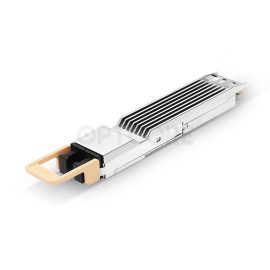
Generic OSFP-800G-DR8 Compatible 800G 2xDR4/DR8 OSFP Finned Top 1310nm 500m Dual MPO-12/APC Transceiver
US$ 899.00 (Excl. VAT) -

Generic Compatible 100G QSFP28 SR4 850nm 100m Transceiver
US$ 29.90 (Excl. VAT) -

Generic Compatible 100G QSFP28 LR4 10km Transceiver
US$ 169.00 (Excl. VAT) -
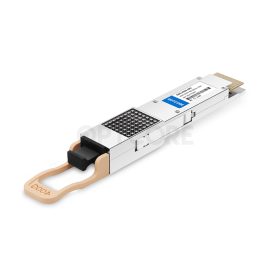
Generic Compatible 400G DR4 QSFP-DD 1310nm 500m MTP/MPO-12 Transceiver
US$ 429.00 (Excl. VAT)
FAQ
#1 Is VXLAN replacing VLAN?
No. VLAN is still widely used in enterprise networks and access layers. VXLAN mainly extends VLAN capabilities in large-scale data center environments.
#2 What is a VNI?
VNI stands for VXLAN Network Identifier. It is a 24-bit identifier used to distinguish different VXLAN networks.
#3 Does VXLAN require special switches?
Most VXLAN deployments use switches that support VXLAN tunneling and VTEP functionality.
Conclusion
Both VLAN and VXLAN play critical roles in networking architecture. VLAN is a technology that offers an easy and efficient way to segment traffic on standard local area networks. On the other hand, VXLAN allows achieving the necessary level of scalability for such cloud platforms and data center networks. It would be helpful to know VLAN vs VXLAN and how these technologies operate and interact.
Read more
- What is Port Triggering? The Simple Guide
- VLAN vs Subnet: What is the Difference?
- InfiniBand vs. RoCE: Understanding the Differences For Artificial Intelligence Data Center
