


 Optical Transceiver
 DAC/AOC Cable
 Fiber Cabling
 Networking
Blog, Optical Transceiver
What is the LRO Transceiver? The Simple Guide to Linear Receive Optics

May
We already know that in today’s rapidly evolving optical transceiver industry, power consumption is a major concern. After learning that LPO transceivers reduce power consumption by removing DSPs, people also began to worry about the disadvantages of the lack of full signal compensation capability. So, is there a solution that can keep the strong performance of DSP chips while still reducing part of the power consumption? This is where the LRO transceiver comes in.
The LRO Transceiver removes the DSP on the receive side while still keeping the DSP structure on the transmit side. This allows the module to reduce power consumption while still retaining some retiming capability.
Table of contents
Why Is LRO Transceiver Getting Attention
As 112G PAM4 SerDes gradually becomes more common, signal integrity problems in high-speed links are also becoming more obvious. When signals travel across PCBs, they are affected by insertion loss, crosstalk, jitter, EMI, and return loss. Because of this, high-speed modules require DSPs to continuously perform Equalization, FEC, Clock Recovery, and retiming to maintain a stable bit error rate. However, this method also creates clear problems. Many 800G DSP modules now consume more than 20W, and some even 30W. A single module itself can become a major heat source inside a switch.
As a result, the industry began exploring ways to reduce DSP power consumption through LPO. By completely removing the DSP, the LPO transceiver greatly reduces module power consumption and link latency, making it very suitable for short-distance AI cluster environments. But at the same time, LPO also started showing some problems. Since it lacks full DSP compensation capability, LPO places much higher requirements on the host ASIC, PCB quality, and overall system signal integrity. In many cases, the switch chip must have very strong SerDes capability to drive LPO links stably.
LRO is positioned right between traditional DSP modules and the LPO transceiver. It does not use full dual-direction DSPs like traditional Retimed Optics, nor does it completely remove DSPs like LPO. Instead, it retains some retiming capability, reduces system pressure on the host side, and continues to lower power consumption and costs. As a result, the LRO transceiver has gradually attracted attention from many switch vendors and AI networking equipment manufacturers.
What Is an LRO Transceiver
LRO (Linear Receive Optics) is essentially a half-retimed optical module architecture. Traditional high-speed optical modules typically deploy DSPs on both the transmit and receive sides to perform full digital recovery across the entire link. The LPO transceiver completely removes the DSP. LRO transceiver, however, retains only the DSP and Retimer structures on the transmit path, while the receive path uses a Linear Receiver architecture for linear reception.
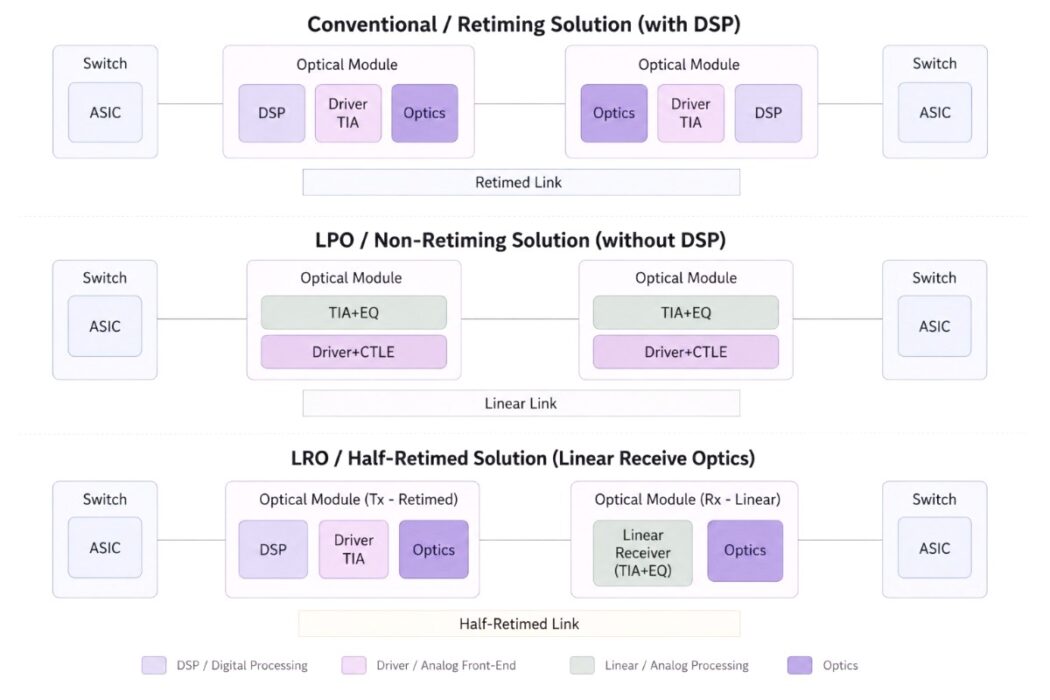
LRO transceiver allows the transmit side to continue handling signal shaping, clock recovery, and part of the bit error compensation to ensure output signal quality. On the receive side, it minimizes DSP involvement and offloads part of the signal-recovery work to the host ASIC. This reduces overall module power consumption while retaining some retiming capability.
Compared with LPO, the biggest feature of LRO is that it “keeps half of the DSP capability.” Because of this, it does not depend on the host system as heavily as LPO, while also avoiding the very high power consumption of traditional DSP modules. In many situations, LRO is seen as a middle-ground solution that balances performance, compatibility, and power consumption.
LRO transceiver may also be called Half-Retimed Optics, HALO (Half-Retimed Linear Optics), TRO (Transmit Retimed Optics), or RTLR (Retimed Transmit Linear Receive). These names all belong to very similar technical approaches. They are all attempts to balance power consumption and performance.
Specifications
- Overall power consumption is clearly reduced while still keeping part of the DSP retiming capability.
- Link stability is usually better than pure LPO transceiver solutions.
- Lower dependence on the host ASIC compared with LPO.
- Lower latency than traditional dual-DSP retimed modules.
- Reduce heat output to support high-density deployment.
- More suitable as a transition solution from traditional DSP modules to LPO.
Limitations
- Power consumption is still higher than fully linear LPO solutions.
- The receive side still requires the host system to participate in signal recovery.
- Transmission distance is still limited by the linear architecture.
- System-level signal integrity requirements are still high.
- Compatibility with future 224G SerDes remains a challenge.
LRO vs LPO vs Traditional Optics
| Comparsion | Traditional Optics | LRO | LPO |
|---|---|---|---|
| DSP Configuration | Tx + Rx DSP | Tx DSP Only | No DSP |
| Power Consumption | Highest | Medium | Lowest |
| Latency | Higher | Medium | Lowest |
| Signal Recovery Capability | Strongest | Medium | Lowest |
| Transmission Distance | Longer | Medium | Shorter |
| Thermal Output | Highest | Reduced | Lowest |
| Module Complexity | Highest | Medium | Simplified |
Although the LRO transceiver can clearly reduce power consumption, it will not completely replace traditional DSP modules. Traditional Retimed Optics still offer the most mature link-recovery capability and the longest transmission distance, making them very important in complex network environments. Compared with LPO, LRO is a more balanced solution. It does not depend on the host ASIC as heavily as LPO, so for many current AI networking systems, LRO is actually easier to deploy in real environments.
Key Application Scenarios
Hyperscale Data Centers
For hyperscale data centers, saving just a few watts per module can make a significant difference in total energy usage. LRO helps reduce overall power supply and cooling costs for the data center. At the same time, because it is easier to support existing hardware than LPO, the LRO transceiver is easier for many hyperscale operators to deploy gradually as they upgrade their AI networks.
Transition Solution Between Traditional DSP and LPO
Many vendors are not planning to switch completely to LPO immediately. Fully linear architectures place very high requirements on switch chips and system design. Because of this, the LRO transceiver is often viewed as an important transition solution. It can reduce power consumption while retaining some of the stability advantages of DSPs. For this reason, LRO will likely continue to exist together with LPO and traditional DSP modules for many years.
High-Speed Interconnects Inside AI Training Clusters
Many AI training clusters have already started deploying large numbers of 400G and 800G links. GPU servers need continuous high-bandwidth, low-latency communication while also managing power and thermal pressure. Compared with traditional DSP modules, the LRO transceiver can significantly reduce power consumption. Compared with LPO, it can still retain some signal recovery capability. Because of this, LRO is gradually becoming a more realistic middle-ground solution inside AI Spine-Leaf networks and GPU Fabric environments.
As AI networking and 800G high-speed interconnects continue to evolve, OPTCORE is also continually focusing on high-speed optical transceivers. Continuously optimize low-power, high-density, and high-speed interconnect capability to help users build more efficient and stable data center networks.
-
Generic Compatible 400G FR4 QSFP-DD 1310nm 2km LC Transceiver
US$ 459.00 (Excl. VAT) -
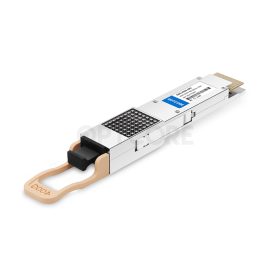
Generic Compatible 400G DR4 QSFP-DD 1310nm 500m MTP/MPO-12 Transceiver
US$ 429.00 (Excl. VAT) -
Single Mode OS2 MPO to MPO Trunk Cable, 12 Fiber, Female, Type B, LSZH
Price range: US$ 22.00 through US$ 104.00 (Excl. VAT) -
Multimode OM4 MPO to MPO Fiber Trunk Cable, 12 Fiber, Female, Type B, LSZH
Price range: US$ 21.10 through US$ 283.50 (Excl. VAT)

Future Development of LRO Transceiver
As 112G PAM4 matures and 224G SerDes enters the next stage, demand for lower power consumption and higher density in the optical transceiver industry will continue to grow. The number of links inside future AI training networks will also continue increasing, making lower per-port power consumption a very important issue. The future direction of the LRO transceiver will likely continue focusing on balancing power consumption and stability.
Compared with traditional DSP modules, it can reduce part of the heat and power pressure. Compared with LPO, it can reduce system-level design difficulty. Because of this, many vendors are starting to see LRO as a more realistic and easier-to-deploy solution.
At the same time, as switch-chip SerDes capabilities continue to improve, the boundary between LRO and LPO may gradually become less clear. Many next-generation high-speed modules may use more flexible Hybrid Linear architectures that dynamically adjust DSP participation in different directions, further optimizing the balance between power consumption, latency, and link stability.
FAQs
#1 Is LRO the same as LPO?
No. LRO transceiver still retains DSP on the transmit side, while LPO removes DSP entirely.
#2 Does LRO consume less power than traditional DSP optics?
Yes. Although the power reduction is not as large as LPO, the LRO transceiver removes the receive-side DSP, so overall module power consumption is still lower than fully retimed optics.
Conclusion
The optical transceiver industry is always improving and evolving. There is always a need for a more balanced solution between power consumption, latency, and stability. The appearance of the LRO transceiver is also part of this trend. Linear-Receiver Optics serves as a transitional technology in AI data centers, balancing cost and power savings with improved interoperability, making it a stepping stone toward future solutions such as full LPO or co-packaged optics.
Read more
- What is an LPO Transceiver? A Beginner’s Guide to Linear-drive Pluggable Optics
- 400G SR4 vs DR4 vs FR4 vs LR4: What Are the Differences and How to Choose?
- MPO/MTP® Jumper, Harness, and Trunk Cables: What Are the Differences and How to Choose?
