


 Optical Transceiver
 DAC/AOC Cable
 Fiber Cabling
 Networking
Blog, Optical Networking
MPO/MTP® Jumper, Harness, and Trunk Cables: What Are the Differences and How to Choose?

Apr
With the development of high-speed network transmission (40G, 100G, 400G, etc.), the density of fiber cabling systems is also increasing. In high-density data centers and cloud infrastructure scenarios, MPO/MTP® cables and related components are becoming the mainstream of cabling. This article will introduce MPO/MTP® Jumper Cables, Harness Cables, and Trunk Fiber Cables. From structural features to application differences, this article helps you better understand these components and make better choices when planning fiber cabling.
Table of contents
What is MPO/MTP Cables
Before understanding MPO/MTP® Jumper, Harness, and Trunk Cables, let us first look at what MPO/MTP® cables are and build a basic understanding.
MPO cable: A high-density, low-loss connection cable that supports plug-and-play. So it is widely used in high-speed communication networks. Common types include MPO12, MPO24, MPO8, etc.
MTP cable: MTP® is a registered trademark of US Conec. It is essentially an upgraded version of MPO cables. While MTP cables provide better lifespan, signal integrity, and dust protection. At the physical interface level, they are fully compatible with MPO cables and can be used as direct replacements.
-

50/125 Multimode OM3 MTP Elite Trunk Cable, 12 Fiber, Female, Type B, LSZH
Price range: US$ 32.00 through US$ 116.00 (Excl. VAT) -
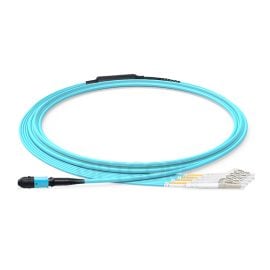
MPO Female to 4 LC Duplex Fiber Breakout Cable, 8 Fiber 50/125 Multimode OM3, Type B, LSZH
Price range: US$ 25.00 through US$ 223.00 (Excl. VAT) -
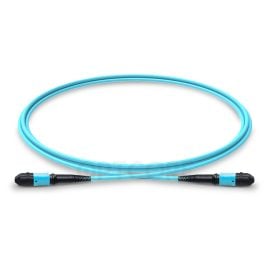
Multimode OM3 MPO to MPO Trunk Cable, 12 Fiber, Female, Type B, LSZH
Price range: US$ 19.00 through US$ 173.00 (Excl. VAT) -
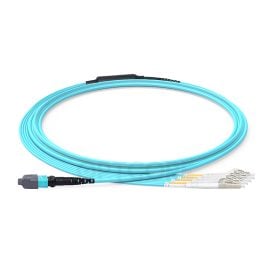
MTP® Female to 4xLC Duplex 50/125 Multimode OM3 Fiber Optic Harness Cable, Polarity B, LSZH
Price range: US$ 32.00 through US$ 49.00 (Excl. VAT)
Why are MTP/MPO cables important for modern data center cabling?
- High fiber density with better usability
- Replace complex traditional cabling with plug-and-play deployment.
- Scalability up to 400G
Compared with traditional cabling, MPO/MTP® cables offer these advantages. By properly using MPO/MTP® Jumper, Harness, and Trunk Cables, you can standardize your cabling and reduce clutter. A good cabling design can greatly reduce future operation and maintenance costs. Because of advancements in AI models (including LLM training), the bottleneck in networking will shift from the computing end to the bandwidth interconnection end. Dense MPO cabling offers shorter connection paths, reduced losses, and better maintenance opportunities.
What are MPO/MTP® Jumper, Harness, and Trunk Fiber Cables
MPO/MTP® Jumper Cables
Jumper Cables are direct connection cables. Their short distance (1–30m) and high flexibility allow them to connect devices inside racks. So they are used for connections between optical module ports or between devices and patch panels, and are the basic components for short-distance connections in high-density cabling.
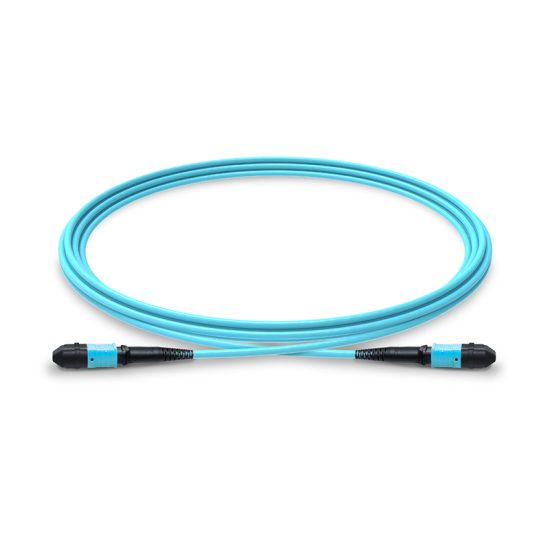
In actual structure, Jumper focuses on “port-level connection,” usually connecting directly to optical modules (such as QSFP, OSFP) or patch panel ports. Its design focuses on low insertion loss, good bending performance, and stability under frequent plugging. In high-maintenance environments (such as ToR switch areas), Jumper is the most active physical connection component.

MPO/MTP® Harness Cables
Harness Cables are breakout cables. The breakout cable we often mention is a type of Harness Cable. This type of cable is used to distribute high-density links to multiple lower-speed servers, allowing flexible connections between different rates. Harness cables can realize link equivalence, such as splitting one 800G optical module into four 200G links. It plays a role in structure conversion and helps maximize port utilization in server access or mixed-rate networks.
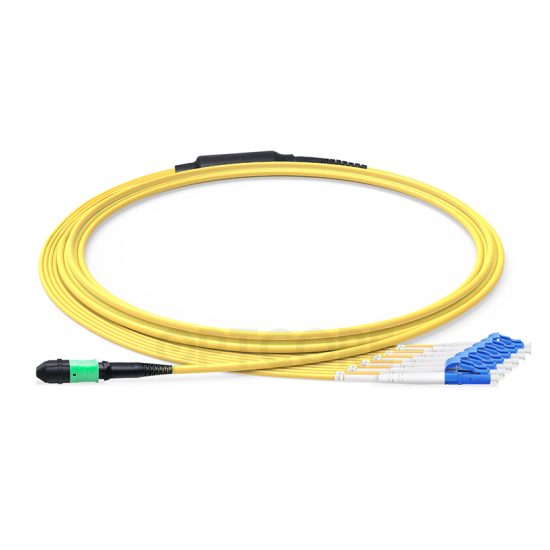
From a structural perspective, the core value of Harness is “interface mapping.” For example, one 8-fiber MPO can be split into 4 LC duplex connectors. This matches the lane structure of optical modules (such as 4×25G or 4×50G). This structure aligns the optical layer with the electrical layer, reducing extra conversion loss.
MPO/MTP® Trunk Cables
Trunk Cables are mainly used as backbone cables between racks and cabinets. It is essentially a high-density multi-fiber MPO cable (48, 72, 96, 144 fibers or more). Unlike Jumper cables, MPO/MTP® Trunk cables usually do not connect directly to optical modules. Instead, they rely on patch panels to distribute fibers. For example, connections between the Main Distribution Area (MDA) and the Horizontal Distribution Area (HDA). Trunk cables carry multiple signals.

In addition, the Trunk design is optimized for long-term, stable transmission and structured cabling. Such cables are generally pre-terminated and factory tested to ensure reliable link loss. In big data centers, Trunk uses MPO cassette modules in order to convert higher counts of fibers into LC/MPO ports.
Their Difference and How to Choose
The main differences are shown in the table below, along with typical use cases.
| Jumper | Harness | Trunk | |
|---|---|---|---|
| Structure | Point-to-point | One-to-many | High fiber backbone |
| Connection | Module ↔ Module / Panel | Module ↔ Multiple devices | Panel ↔ Panel |
| Function | Short reach | Breakout / conversion | Backbone |
| Fiber Count | 8/12/24 | 8→4×LC etc. | 24/48/72/96+ |
| Flexibility | High | Medium | Low |
| Scenario | In-rack | Rate breakout | Data center backbone |
Applications
#1 Data Centers / Rack-to-core cabling:
This scenario matches a typical Leaf-Spine architecture, where connections go from racks to aggregation/core switches. In practice, 24-fiber or 48-fiber (or higher) MPO/MTP® Trunk cables are used. Multiple 100G or 400G links are carried in one cable and then distributed through patch panels. This is a common practice in standards such as TIA-942.
#2 Enterprises / Server patching:
In enterprise environments, there is usually no backbone aggregation. Most connections are short-distance device-to-device or device-to-panel. Therefore, the MPO Jumper is commonly used. A typical example is a QSFP module to MPO panel connection, providing low loss and easy maintenance.
#3 Telecom Operators / Central office backbone:
In telecom core sites, Trunk cables are used as backbone connections (such as ODF to ODF), and then split by cassette into LC or MPO interfaces for devices. This “Trunk + patch panel” structure is very common in 100G metro networks.
#4 Cloud Provider / AI/HPC Clusters:
In cloud providers and AI clusters, many servers are connected, leading to extensive connectivity. Trunks with high fiber counts are employed to connect racks at scale. These reduce cabling complexities and also provide flexibility to scale further by adding higher-speed 400G connectivity in the future.
FAQs
# 1 Is Harness cables means Breakout cables?
A harness is essentially a type of breakout cable. “Breakout” describes the function, while “Harness” describes the structure.
#2 Is Trunk one cable or many cables?
Trunk is always one physical cable, but it contains multiple fibers inside. It is distributed logically through patch panels, not physically split into separate cables.
Conclusion
The high-density feature makes MPO/MTP® Jumper, Harness, and Trunk Cables the popular choice when talking about structured cabling. Whether it is a small business or a huge data center, there are always proper cable choices to meet your demands. A good selection of cables will ensure a solid network link.
Read more
- MPO-8, MPO-12, or MPO-24? Choosing the Right Backbone for Your 400G Infrastructure
- MTP vs MPO connector: What is the difference?
- Optcore MPO/MTP Fiber Cables Recommendation
