


 Optical Transceiver
 DAC/AOC Cable
 Fiber Cabling
 Networking
Blog
MPO-8, MPO-12, or MPO-24? Choosing the Right Backbone for Your 400G Infrastructure
Mar
In the early stage of information development, people pursued the upper limit of speed. From 1G to 10G and then to 100G, the increase in data rate brought huge iterations in network development. Now, with 400G and even 800G, when network speed is already sufficient for use, more people are focusing on link quality. Within a limited space, the cabling structure also becomes the upper limit of link development. It may determine your future link expansion method and the upgrade cost you need. In high-speed links, choosing MPO-8, MPO-12, or MPO-24 is very important for long-term network deployment. Read this article to choose the right backbone for your 400G infrastructure.
Table of contents
MPO-8
MPO-8 patch cable is not actually a standardized infrastructure interface. It has only 8 fibers in one row, so it fully aligns with the SR4 design. This result makes it widely used in 40G SR4 and 100G SR4. It achieves an end-to-end full fiber connection. Compared with the most widely used MPO-12, it improves network efficiency and reduces fiber waste. In actual application, only the outer fibers are used for transmission, while the middle fibers remain idle. This design reduces fiber waste and also leaves room for future system upgrades.
However, the ecosystem of MPO-8 is not as mature as that of MPO-12. Many traditional cabling systems are still based on 12 fibers. Blindly switching to MPO-8 just to save fibers may require major adjustments. In addition, the carrying capacity of 8-fiber patch cords per connector is often lower than that of 24-fiber solutions.
MPO-12
MPO-12 is a standardized interface widely used in data centers, and it has very good compatibility. Each connection contains 12 fibers, and its fiber density is higher than MPO-8. Because of its high compatibility, it not only supports SR4 links but also most QSFP links, including 40G, 100G, 200G, and 400 G. It is widely used in short-distance high-speed direct connections. This makes it very common in deployments between servers and switches.

However, in large-scale deployments, MPO-12 cannot fully utilize all fibers, leaving some fibers idle and resulting in resource waste. In high-usage scenarios, this disadvantage becomes more obvious. At the same time, when upgrading to 400G or 800G, MPO-12 usually requires module cassettes or patching conversion. This increases link complexity and introduces additional insertion loss.
-
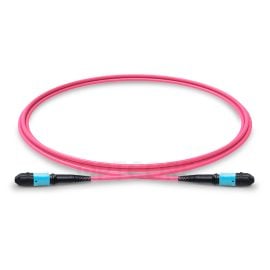
50/125 Multimode OM4 MPO Fiber Trunk Cable, 12 Fiber, Female, Type A, LSZH
Price range: US$ 21.10 through US$ 283.50 (Excl. VAT) -
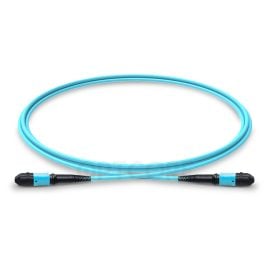
Multimode OM3 MPO to MPO Trunk Cable, 12 Fiber, Female, Type A, LSZH
Price range: US$ 19.00 through US$ 173.00 (Excl. VAT) -

Generic Compatible 100G QSFP28 SR4 850nm 100m Transceiver
US$ 29.90 (Excl. VAT) -
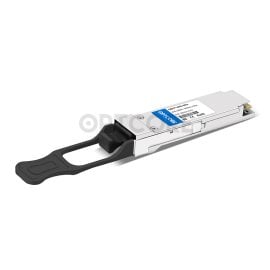
Generic Compatible 40GBASE-SR4 QSFP+ 850nm 100m Transceiver
US$ 23.00 (Excl. VAT)
MPO-24
MPO-24 is designed for high-bandwidth applications. Each connector has 24 fibers, which maximizes fiber utilization. Under the same fiber requirement, it greatly reduces installation time and also brings convenience for later maintenance. At the same time, it provides good scalability for 400G and 800G.
However, its design for high-density scenarios makes it more sensitive to contamination and maintenance. The deployment cost is also higher than MPO-8 and MPO-12. While it becomes convenient in large-scale networks, it may become a cost burden and lead to underutilization in small and medium-sized networks.
-
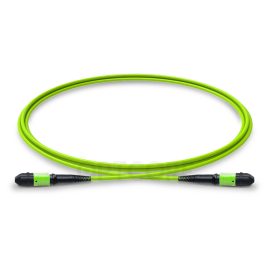
Multimode OM4 MPO-24 to MPO-24 Trunk Cable, 24 Fiber, Female, Type A, LSZH
Price range: US$ 46.00 through US$ 573.00 (Excl. VAT) -
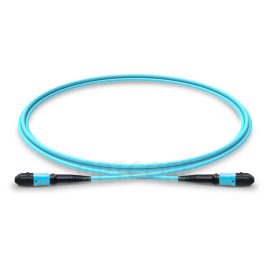
Multimode OM3 MPO-24 to MPO-24 Trunk Cable, 24 Fiber, Female, Type A, LSZH
Price range: US$ 39.00 through US$ 338.00 (Excl. VAT) -
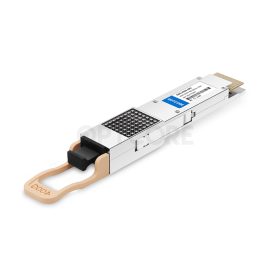
Generic QSFPDD-400G-SR8 Compatible 400GBASE-SR8 QSFP-DD 850nm 100m Transceiver
US$ 139.00 (Excl. VAT) -
Generic Compatible 400G DR4 QSFP-DD 1310nm 500m MTP/MPO-12 Transceiver
US$ 429.00 (Excl. VAT)
Main Comparison and Differences in Application
Different from traditional understanding, many people may think newer is better or that more fibers are better, but choosing MPO patch cables does not follow this rule. MPO-8 actually has the highest utilization efficiency, MPO-12 becomes the most common choice, and MPO-24 is more designed for high bandwidth.
Comparison Table
| Type | Fiber Count | Utilization Efficiency | Compatibility | Density | Typical Use |
|---|---|---|---|---|---|
| MPO-8 | 8 | High | Medium | Medium | SR4 / AI / Spine-Leaf |
| MPO-12 | 12 | Medium | High | Medium | General DC / Legacy |
| MPO-24 | 24 | High | Medium | High | High-density / 400G+ |
Application Scenarios
In different network scales and stages, different MPO choices correspond to different needs. In actual applications, engineers usually make adjustments based on real scenarios. This helps in planning the cabling strategy and expansion path.
- For small and medium enterprise networks or small data centers, this scenario should first consider deployment costs and risks. Under this condition, MPO-12 is the most common choice. Many existing systems are built around 12 fibers, and choosing the safest strategy is enough for daily upgrades.
- For cloud computing or AI-oriented high-performance data centers, long-term development and costs should be given more consideration. Under this condition, MPO-8 is more common. Because SR4 links are designed with 8 fibers, MPO-8 can achieve full utilization without redundant fibers. In large-scale Leaf-Spine architectures, this advantage will be amplified. From a long-term perspective, cabling complexity and maintenance cost are greatly reduced.
- For high-density patching areas, this type of scenario requires providing more links in a limited space and reducing the usage of patch panels. The advantage of MPO-24 begins to show. It provides more high-speed link options in a limited space, such as carrying a large number of 400G links in a single rack or preparing for 800G upgrades.
Selection in 400G Scenarios
In 400G networks, the mainstream optical module types are 400G SR8 and 400G DR4/FR4, and different module forms affect the choice of MPO.
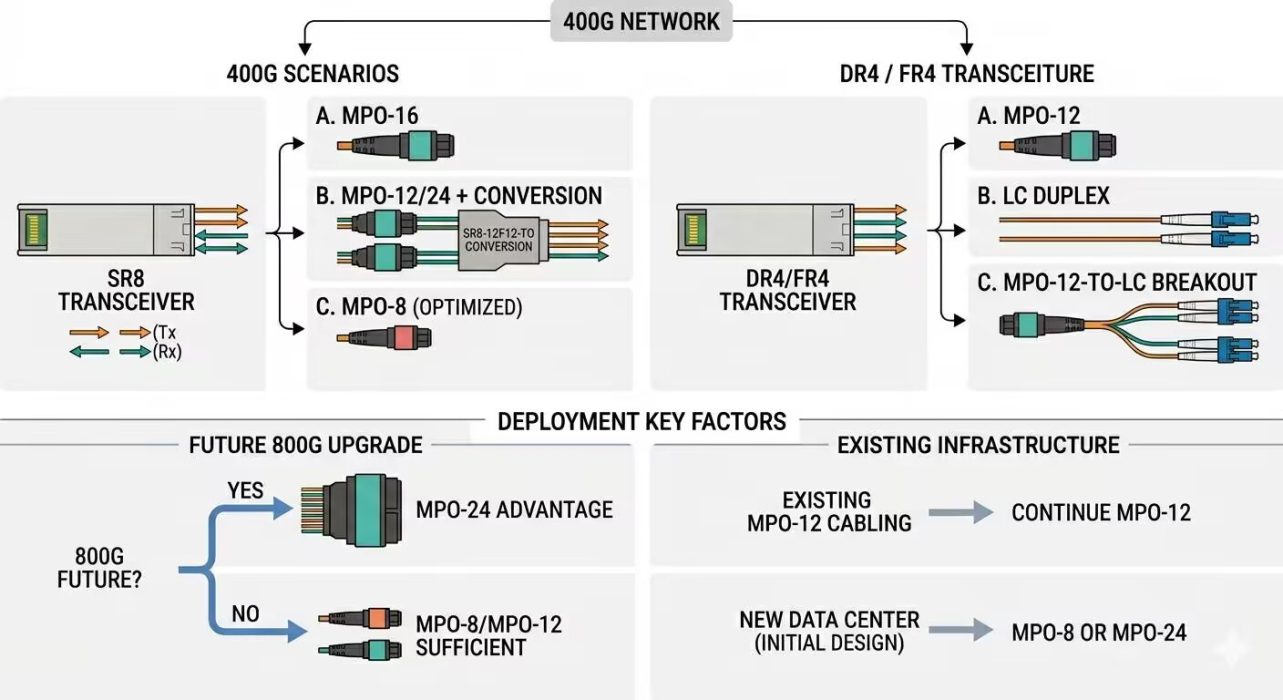
If it is an SR8 architecture, it is essentially 8 transmit and 8 receive, with a total of 16 fibers participating in transmission. In this case, MPO-16 is usually used, or MPO-12 / MPO-24 is used with conversion to achieve link connection. However, in some designs that focus more on utilization optimization, the MPO-8 structure is preferred to reduce redundant fibers. This is also why MPO-8 is starting to be considered more in some new projects.
If it is DR4 / FR4 with a 4-channel structure, it requires fewer fibers; MPO-12 or LC duplex solutions are more flexible. In many practical projects, the MPO-12-to-LC breakout is also used for link splitting and distribution to accommodate different device interfaces.
In actual deployment, a key point is whether there is a clear 800G upgrade plan. If there is a future upgrade requirement, MPO-24 has more advantages. It is designed for high-density cabling and makes it easier to transition to higher-speed architectures in terms of channel count and structure. If deployment only focuses on 400G, MPO-8 or MPO-12 can already meet most requirements.
Another factor to consider is the existing infrastructure. If the current data center already uses MPO-12 cabling, continuing to use it is more economical and easier to implement. If it is a new data center, there is no need to consider transformation cost, and introducing MPO-8 or MPO-24 in the initial design provides more space for future expansion and upgrades.
FAQs
#1 Is MPO-12 obsolete for 400G?
Many existing data centers still run based on MPO-12 because of its compatibility and standardization. Especially with module cassettes or patching conversion, it can still support 400G. If cost and space are not considered, from the perspective of efficiency only, MPO-8 or higher-density solutions are more direct.
#2 Why is MPO-8 considered more efficient?
Because for the most widely used short-distance high-speed links, SR4 only requires 8 fibers. MPO-8 can achieve full utilization, while MPO-12 will have idle fibers. In large-scale deployments, this difference will translate into cost and space differences.
Conclusion
There are many types of MPO cables. MPO-8, MPO-12, and MPO-24 each have different characteristics in density, fiber utilization, and application flexibility. By choosing the right connector, you can achieve better deployment for your 400G links.
Read more
- Understanding Terabit Ethernet: 100G, 200G, 400G, and 800G
- Understanding CS Connector for Fiber Patch Cable: A Beginner’s Guide
- SFP+, SFP28, QSFP+, QSFP28, QSFP56, QSFP-DD, QSFP112 vs OSFP, What are the differences?
