


 Optical Transceiver
 DAC/AOC Cable
 Fiber Cabling
 Networking
Blog, Optical Transceiver
OSFP vs OSFP-XD for 1.6T Transceiver: Key Differences and Comparison
Jun
Cloud computing and big language models are growing super fast, boosting bandwidth needs even more. Optical transceivers started at 100G, jumped to 400G and 800G, and now 1.6T versions are coming up. These transceivers are designed specifically for hyperscale data centers. For the 1.6T transceiver, there are two representative form factors based on OSFP: OSFP vs OSFP-XD. Although both can deliver 1.6 Tbps bandwidth, there are clear differences in their design philosophies, technical approaches, and application scenarios.
This article provides a detailed introduction to these two 1.6T transceiver form factors, covering their appearance, design goals, and deployment scenarios.
Table of contents
Why Did 1.6T Optical Transceivers Emerge?
The growth of data center switch bandwidth has mainly been driven by higher SerDes speeds. Every electrical interface upgrade brings a significant increase in switching capacity. Today’s mainstream 51.2Tbps switch ASICs are already widely deployed in 800G networks. However, switch ASIC bandwidth is rapidly approaching 102.4 Tbps and even 204.8 Tbps. In large GPU clusters, thousands or even tens of thousands of GPUs need to frequently synchronize parameters and gradient data. More high-speed interfaces are required to fully utilize the available switching capacity.
If we keep using 800G transceivers for network setups, we’ll need way more switches, optical transceivers, and fiber links to handle the traffic. This makes networks messier and riskier, plus it costs more. To boost the power of new switch silicon, the industry is now pushing for 1.6T optical transceivers. With these, higher per-port bandwidth can reduce device counts, increase port density, and simplify AI network designs.
What is 1.6T OSFP?
OSFP (Octal Small Form-factor Pluggable) is currently one of the mainstream high-speed optical transceiver form factors used in AI data centers and high-performance computing networks. Compared with QSFP-DD, OSFP offers more internal space, stronger thermal performance, and a higher power budget. According to the OSFP MSA, the OSFP module was designed from the beginning to handle 400G/800G speeds and, with the release of the OSFP 4.0 specification, now supports dual 400G and octal 100G breakout modules with several fiber connector options.
Unlike 800G OSFP modules, which use an 8 × 100G electrical lane architecture, 1.6T OSFP modules continue to use eight lanes but upgrade each lane to 200 Gbps PAM4. This design achieves a total bandwidth of 1.6Tbps without increasing the lane count. The biggest advantage of this approach is that it continues the existing OSFP ecosystem while gaining higher bandwidth density through faster lane speeds. It maintains mechanical continuity and supply chain compatibility as much as possible, too.
Still, since 224G SerDes requires enhanced signal integrity, 1.6T OSFP upgrades its internal PCB design, connector build, and thermal systems. This lets it meet the demands of newer switch ASICs and quicker data links. Plus, data centers running 400G and 800G OSFP can easily step up to 1.6T OSFP.
-
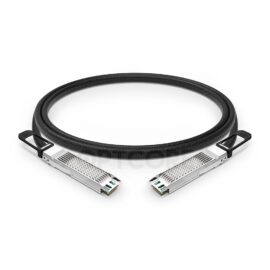
0.5m (2ft) Nvidia MCP4Y10-N00A Compatible 800G OSFP Finned Top DAC Cable
US$ 99.00 (Excl. VAT) -
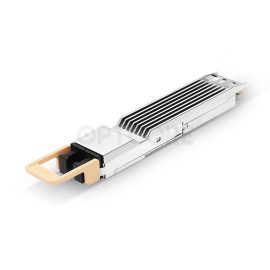
Generic OSFP-800G-SR8 Compatible 800G 2xSR4/SR8 OSFP Finned Top 850nm 100m Dual MPO-12/APC Transceiver
US$ 599.00 (Excl. VAT) -
Generic OSFP-800G-DR8 Compatible 800G 2xDR4/DR8 OSFP Finned Top 1310nm 500m Dual MPO-12/APC Transceiver
US$ 899.00 (Excl. VAT) -
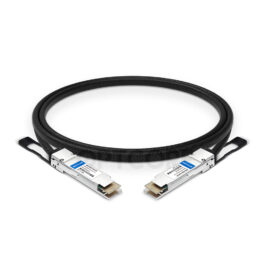
0.5~2m Generic QDD-800G-DAC Compatible 800G QSFP-DD DAC Cable
Price range: US$ 119.00 through US$ 199.00 (Excl. VAT)
Key Specifications and Advantages
- 8 × 200G PAM4 architecture delivers 1.6Tbps total bandwidth
- Continues the existing OSFP ecosystem
- Fewer lanes reduce PCB routing complexity.
- Supported by a relatively mature supply chain
What is 1.6T OSFP-XD?
OSFP-XD (OSFP eXtra Dense) is a new form factor proposed by the OSFP MSA for future ultra-high-density networks. Unlike 1.6T OSFP, which increases bandwidth by raising per-lane speed, OSFP-XD achieves higher bandwidth by increasing the number of lanes. Based on the mature 112G PAM4 ecosystem available today, OSFP-XD expands the traditional eight high-speed electrical lanes to sixteen. This allows it to achieve a total bandwidth of 1.6 Tbps, with each lane operating at 100 Gbps.
To handle the extra lanes, OSFP-XD uses a dual-row high-speed contact design and makes modules bigger and PCBs thicker. This makes it handle complex routing and power needs better. OSFP-XD is more of a port density for the future than OSFP1600. It can upgrade to 3.2Tbps via 16 × 200G in a 16-lane configuration. However, its interfaces are not compatible with the existing OSFP designs. So, they are working on the large-scale adoption and compatibility with the ecosystem, but it’s not fully there yet.
Key Specifications and Advantages
- 16 × 100G PAM4 architecture delivers 1.6Tbps bandwidth
- Dual-row contact design enables higher port density.
- Larger internal volume supports higher-power modules.
- Designed for next-generation ultra-high-density switch platforms
OSFP vs OSFP-XD
| OSFP 1.6T | OSFP-XD 1.6T | |
|---|---|---|
| Total Bandwidth | 1.6Tbps | 1.6Tbps |
| Electrical Lanes | 8 × 200G | 16 × 100G |
| Lane Strategy | Higher Per-Lane Speed | More Lanes |
| Backward Compatibility | Strong | Limited |
| Mechanical Size | Standard OSFP Family | Extended Design |
| Internal Contact Rows | Single Row | Dual Row |
| Power Capability | High | Higher |
Mechanical Design Differences
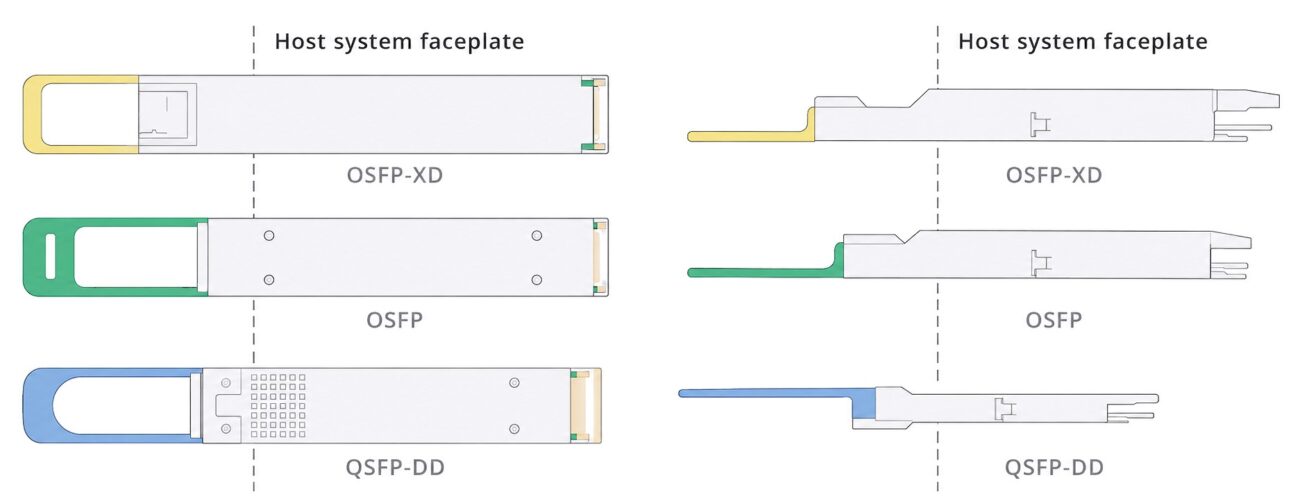
The biggest physical difference between the two solutions comes from their internal connector structures. OSFP continues to use the traditional 8-lane design, so its overall structure remains highly consistent with existing 800G OSFP modules. To support sixteen high-speed electrical lanes, OSFP-XD adds a second row of high-speed contacts inside the module. As a result, the module becomes taller, and its internal volume increases by approximately 20%. The additional space can be used for routing optimization, power delivery networks, and thermal design improvements.
Electrical Channel Architecture
OSFP follows an 8 × 200G technology path and relies on the development of 224G SerDes technology. OSFP-XD follows a 16 × 100G approach and continues to leverage the mature 112G PAM4 ecosystem. The first approach increases total bandwidth through faster electrical lanes, while the second achieves bandwidth growth through a higher lane count.
The biggest benefit of OSFP is its compatibility with the existing ecosystem. OSFP-XD uses a different 16-lane interface and is not compatible with standard OSFP cages and connectors. Therefore, dedicated OSFP-XD systems are required. Neither option is better; it depends on the situation. OSFP vs OSFP-XD, OSFP is a compromise between the present and the possible, making it ideal for commercial applications in the next few years. On the flip side, OSFP-XD is geared towards super high port densities and the need for more bandwidth down the road. It’ll shine in future tech dev and switch design studies.
Real-World Deployment Scenarios and Applications
Data center operators who’ve already deployed many 400G or 800G OSFP systems will find the 1.6T OSFP more practical. Their cabling, switch platforms, and procedures are already set up for OSFP, so an upgrade minimizes changes and speeds things up. Enterprises looking to roll out 102.4 Tbps switches in the next year or two should go with OSFP too, because it has a more robust supply chain and a clearer deployment process.
When orgs plan to build next-gen AI training clusters, scalability’s a biggie. If you want to significantly grow your GPU network over three to five years, the 16-lane architecture and 3.2T path of the OSFP-XD might appeal to you. It’s really handy for evaluating switch arches, checking super dense net designs, or doing tech research. Plus, OSFP vs OSFP-XD, OSFP-XD offers extra flex in planning your system builds.
Optical transceiver vendors, switch makers, and research groups use OSFP-XD mainly to validate tech, not to immediately replace OSFP. It helps explore how future high-density systems could be built. Right now, it works best for lab tests, prototype dev, and planning future products, not for big network rollouts yet.
FAQ
#1 Does OSFP-XD provide higher bandwidth than OSFP?
Currently, both support 1.6Tbps. The difference lies in how that bandwidth is achieved.
#2 Why does OSFP-XD use 16 lanes?
The 16-lane architecture enables 1.6 Tbps bandwidth using existing 100G electrical lanes while providing a path to future 3.2 Tbps applications.
#3 Is OSFP-XD backward compatible with OSFP?
No. OSFP-XD uses a different electrical connector structure and requires dedicated cages and ports.
#4 Which form factor is better for future 3.2T evolution?
OSFP-XD offers a natural path through its 16-lane architecture, while OSFP relies more heavily on next-generation SerDes technology.
Conclusion
With various 1.6T form factors and tech paths, choices get tricky. The options vary in terms of port counts, lane architecture, and module support. OSFP vs OSFP-XD both have their pros and cons. Thus, data center operators need to assess their requirements in advance of deployment. This allows them to select the option that will best support future growth.
Read more
- OSFP IHS vs. OSFP RHS: What Are the Differences and How to Choose?
- Flat Top vs. Finned Top OSFP: A Costly Mistake You Must Avoid in NVIDIA Networking
- SFP+, SFP28, QSFP+, QSFP28, QSFP56, QSFP-DD, QSFP112 vs OSFP, What are the differences?
