


 Optical Transceiver
 DAC/AOC Cable
 Fiber Cabling
 Networking
Blog, Optical Transceiver
Flat Top vs. Finned Top OSFP: A Costly Mistake You Must Avoid in NVIDIA Networking

Apr
It is not hard to notice that in the development of optical communication, from 40G to 100G, the appearance of optical modules has not changed much. However, from 100G to 400G and even 800G, the physical design of these modules has changed significantly. The most common difference on the rear side of the module is two structures: Flat Top vs. Finned Top. In today’s fast development of AI and cloud computing, and with the coming of the 6G era, these different structural designs will bring different effects.
Understanding the differences and characteristics of these structures helps you choose the right components for your NVIDIA Networking. It also helps avoid underperforming your equipment or even causing network failures due to the wrong selection.
What is OSFP Flat Top vs. Finned Top
OSFP transceiver is a module designed for high-speed optical communication networks. Flat Top vs. Finned Top are two different physical appearances of this module. The structural difference changes the thermal resistance path, which affects the working temperature and stability of the module in different systems. It can handle up to 25W or even higher power consumption. Compared with QSFP-DD, OSFP provides more space for heat dissipation in its mechanical design, which also underlies the later differentiation into Flat Top and Finned Top.
Flat Top: The surface of the optical module is flat, without an external heatsink. This form usually makes switch ports more compact. But under high port density, thermal pressure becomes high, which may lead to signal loss.
Finned Top: The surface of the optical module has a finned structure. The uneven structure maximizes the heat-dissipation area, which is particularly important in switches with many high-power modules. But at the same time, the special shape reduces compatibility to some extent and also brings some difficulty in cleaning.
-
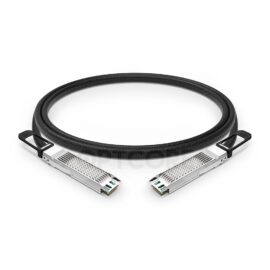
0.5m (2ft) Nvidia MCP4Y10-N00A Compatible 800G OSFP Finned Top DAC Cable
US$ 99.00 (Excl. VAT) -
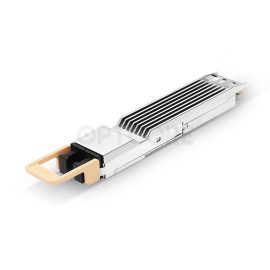
Generic OSFP-800G-SR8 Compatible 800G 2xSR4/SR8 OSFP Finned Top 850nm 100m Dual MPO-12/APC Transceiver
US$ 599.00 (Excl. VAT) -
Generic OSFP-800G-DR8 Compatible 800G 2xDR4/DR8 OSFP Finned Top 1310nm 500m Dual MPO-12/APC Transceiver
US$ 899.00 (Excl. VAT) -
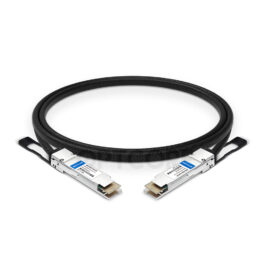
0.5~2m Generic QDD-800G-DAC Compatible 800G QSFP-DD DAC Cable
Price range: US$ 119.00 through US$ 199.00 (Excl. VAT)
Flat Top OSFP
Flat Top OSFP modules use a flat metal top cover structure. The main heat-generating components inside produce heat, which is conducted through thermal interface materials inside the package to the module shell. The heat then spreads along the metal housing to the top surface. Finally, the heat is removed by airflow inside the switch through convection.
It can be seen that this type of module fully depends on the airflow inside the switch for heat dissipation. It is completely determined by the airflow design of the switch. But in environments where airflow is blocked or local hotspots are obvious, heat will accumulate on the module surface, causing the temperature to rise quickly.
Flat Top vs. Finned Top. This design also brings some advantages. The simple structure does not take extra space and has a lower cost. It is also similar to common module structures like 100G, so compatibility in mixed use is better. Therefore, it is easier to achieve higher port density, but the trade-off is higher thermal resistance.
Finned Top OSFP
Finned Top OSFP adds a metal fin structure on the top of the module. The core design is to reduce convective thermal resistance by increasing surface area. The heat conduction path is the same as Flat Top, but in the final stage, the fins expand the original flat heat exchange area into multiple times the effective area. This allows more heat to be carried away when air flows through the module.
The fin configuration also alters the airflow pattern around the fins, thereby creating more complex turbulence on the module surface, which improves heat exchange efficiency. This ensures that Finned Top performs optimally even under conditions of reduced air flow.
At the same time, there are trade-offs. Flat Top vs. Finned Top, this structure requires more vertical space, so greater attention is needed to mechanical compatibility. In addition, the more complex design also brings a relatively higher cost.
Key difference of Flat Top vs Finned Top in OSFP
The table below helps you more clearly see the details and differences between them. For users who want quick reference, it helps make faster decisions.
| Type | Flat Top | Finned Top |
|---|---|---|
| Structure | Flat metal top | Extended fin heatsink |
| Thermal Resistance | Higher | Lower |
| Heat Dissipation Method | Airflow dependent | Surface-enhanced convection |
| Power Envelope | Typically ≤12–15W | Typically ≥15W and above |
| Airflow Requirement | High | Medium |
| Deployment Sensitivity | High (airflow critical) | Lower (more tolerant) |
Application Scenarios
Apart from the differences in physical meaning and hardware aspects such as structure and heat dissipation capability, Flat Top and Finned Top also usually correspond to different application scenarios in actual deployment. These scenario differences are partly determined by the hardware of the module itself, and partly determined by the compatible switch vendors that the module is designed for.
Flat Top:
- Commonly used in small businesses or small to medium-sized data centers
- Suitable for commen network cards such as NVIDIA ConnectX-7 where load density is not high.
- It can also be applied in non-continuous high-load environments, such as test networks, development environments, or non-core business links.
Finned Top:
- Typically deployed in AI training clusters and GPU interconnect networks.
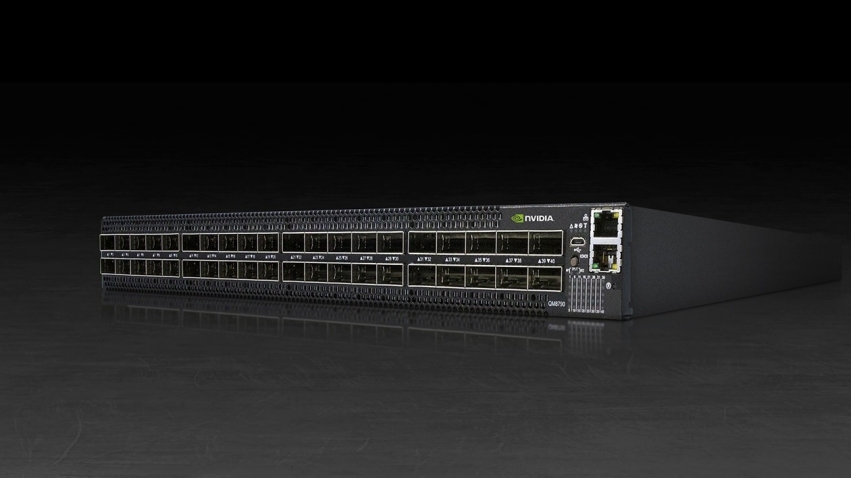
- Widely used in switches and servers. Such as NVIDIA Quantum-2 InfiniBand Switch and NVIDIA Spectrum-4 Ethernet Switch
- More often seen in large-scale data centers at Top-of-Rack or Leaf layers, especially in high-density cabinet deployments.
Common mistakes and how to avoid
#1 Following generic OSFP guidelines instead of NVIDIA platform requirements
In actual deployment, NVIDIA switch thermal architecture is designed based on specific thermal models, including airflow layout, fan curves, and port power assumptions. If these conditions are ignored and selection is made only based on “OSFP standard compatibility,” a system-level mismatch will happen.
#2 Assuming NVIDIA switches can “adapt” to either type dynamically
A common misunderstanding is that modern switches can automatically adapt to Flat Top vs. Finned Top because of smart fan control. In reality, fan adjustment can only compensate for temperature changes within a limited range. If a system is designed for Finned Top but actually uses Flat Top, even running fans at full speed may not make up for the lack of heat dissipation area.
#3 Misinterpreting NVIDIA compatibility as mechanical fit only
Some engineering experts consider the module to be “compatible” if it can simply be placed into the switch. In reality, compatibility in NVIDIA involves mechanical, electrical, and thermal aspects.Flat Top vs. Finned Top. If the module is prone to thermal issues due to high load, even when no link down occurs, performance will be impacted.
#4 Overlooking airflow optimization in NVIDIA rack design
NVIDIA AI clusters usually use standardized rack deployment, and airflow design (such as front-to-back) is part of system optimization. Mixing Flat Top and Finned Top in the same system may break the original airflow distribution. This makes local hotspots harder to predict and increases thermal management complexity, especially in large-scale deployment.
#5 Blindly choosing Flat Top in NVIDIA high-power AI fabrics to save cost
In NVIDIA 400G/800G fabrics, module power consumption is generally high. Flat Top vs. Finned Top. Some projects choose Flat Top to reduce cost because of its simple structure and lower price. But these networks usually run at full load for a long time, with high port density. In such scenarios, Flat Top lacks enough heat dissipation area, which may cause high temperature, triggering throttling or link instability. This “cost over thermal design” decision is a typical hidden risk in NVIDIA AI networks.
How to make the right choice

- Check the switch’s specification first: First, check the switch’s hardware specification. For example, some NVIDIA switches specifically support Flat Top or Finned Top, but only allow one of them to be used.
- Consider the power consumption of the module: 400G OSFP modules consume about 12-15 watts, whereas 800G modules usually consume over 18 watts. The more power consumed, the higher the heat density. Using a finned top is a good choice for preventing overheating.
- Think about the density of your ports: With high-end switches, all ports will be occupied. At that point, a Finned Top will help dissipate more heat under the same amount of airflow.
- Think long term rather than short term: In applications like AI training or cloud computing, you will have your networks running under high load continuously. Flat Top vs. Finned Top, rather than in short-term applications. This can help reduce temperature fluctuations and save costs in maintenance.
In actual deployment, after understanding the structural differences of OSFP, it is also important to match suitable product solutions. OPTCORE products are trusted by many customers and provide both Flat Top and Finned Top OSFP solutions for your 400G/800G networks. Options include DAC and other types. These products have passed compatibility testing and can adapt to various NVIDIA network environments. Choosing OSFP modules with good compatibility and a suitable structure can effectively improve system stability and reduce long-term maintenance risks.
Conclusion
The difference between Flat Top vs. Finned Top OSFP is not only about cost or appearance upgrade. It is a combined solution based on port thermal design and structural optimization. Understanding their differences and use cases helps avoid wrong choices in NVIDIA Networking and allows you to fully utilize your network.
Read more
- Understanding Terabit Ethernet: 100G, 200G, 400G, and 800G
- NVIDIA A100 vs H100 vs L40S vs A6000: A Detailed Comparison
- MPO-8, MPO-12, or MPO-24? Choosing the Right Backbone for Your 400G Infrastructure
