


 Optical Transceiver
 DAC/AOC Cable
 Fiber Cabling
 Networking
Blog, Optical Transceiver
LPO vs LRO vs CPO vs NPO Optics: Understanding The Difference
May
As artificial intelligence continues to develop, interconnect technology is also constantly looking for new breakthroughs. The rapid growth of GPU clusters is pushing bandwidth demand to the TB/s level. Copper-based solutions are gradually reaching their limits when scaling beyond 800G, so modern optical devices are continuing to improve and evolve. New optical interconnect architectures are gradually emerging, such as LPO and LRO, which optimize DSP usage, and CPO and NPO, which are designed to shorten switch PCB trace length.
So what are the differences between LPO vs LRO vs CPO vs NPO optics, and how should they be selected in real deployment environments?
What are they
LPO
LPO (Linear-drive Pluggable Optics) is a pluggable optical transceiver solution based on a linear-drive architecture. Traditional high-speed optical modules usually use DSP (Digital Signal Processor) inside the module for full digital signal recovery. However, this also leads to very high power consumption. LPO removes the DSP as much as possible and only uses a linear driver and a linear TIA to complete signal amplification and transmission. Its core idea is to reduce digital processing stages and keep the high-speed signal as close to its original condition as possible, thereby reducing module power consumption and latency.
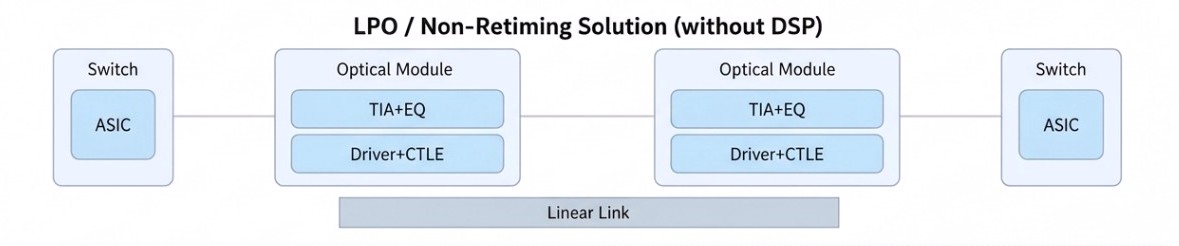
The biggest advantages of LPO are low power consumption and low latency. Since the DSP is removed, the power consumption of 800G LPO modules is usually much lower than traditional Retimed Optics. However, LPO also has obvious limitations. Because it lacks full DSP compensation capability, it depends heavily on the SerDes capability of the switch ASIC itself, and signal integrity will also decrease. Therefore, it is usually more suitable for short-distance and high-quality link environments.
LRO
LRO (Linear Receive Optics) is also commonly called Half-Retimed Optics. Compared with LPO, which completely removes the DSP. LRO keeps DSP and Retimer structures on the transmit side, while the receive side uses a linear receiving method. This allows the transmit direction to still maintain some signal shaping, clock recovery, and bit error compensation capability, while the receive side transfers part of the signal recovery work to the host ASIC.
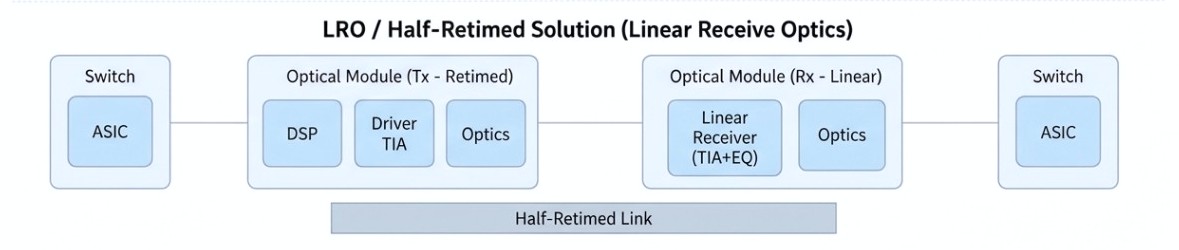
LPO vs LRO, LRO keeps part of the DSP capability, so link stability and compatibility are usually better. Also the dependency on the host ASIC is lower. At the same time, its power consumption is lower than traditional dual-DSP Retimed Optics, so many vendors consider LRO to be a more realistic and easier transitional solution for deployment.
NPO
NPO (Near-Packaged Optics) is a near-packaged optical interconnect architecture. Its core idea is to shorten the high-speed electrical connection distance between the ASIC and optical devices. In traditional hot-pluggable module architectures, the switch ASIC is usually located in the center of the PCB, while the optical module is located on the front panel. High-speed signals need to travel through long PCB traces before reaching the module. This creates large insertion loss and power consumption. NPO places the Optical Engine directly next to the ASIC, reducing the high-speed electrical connection distance to only a few centimeters.
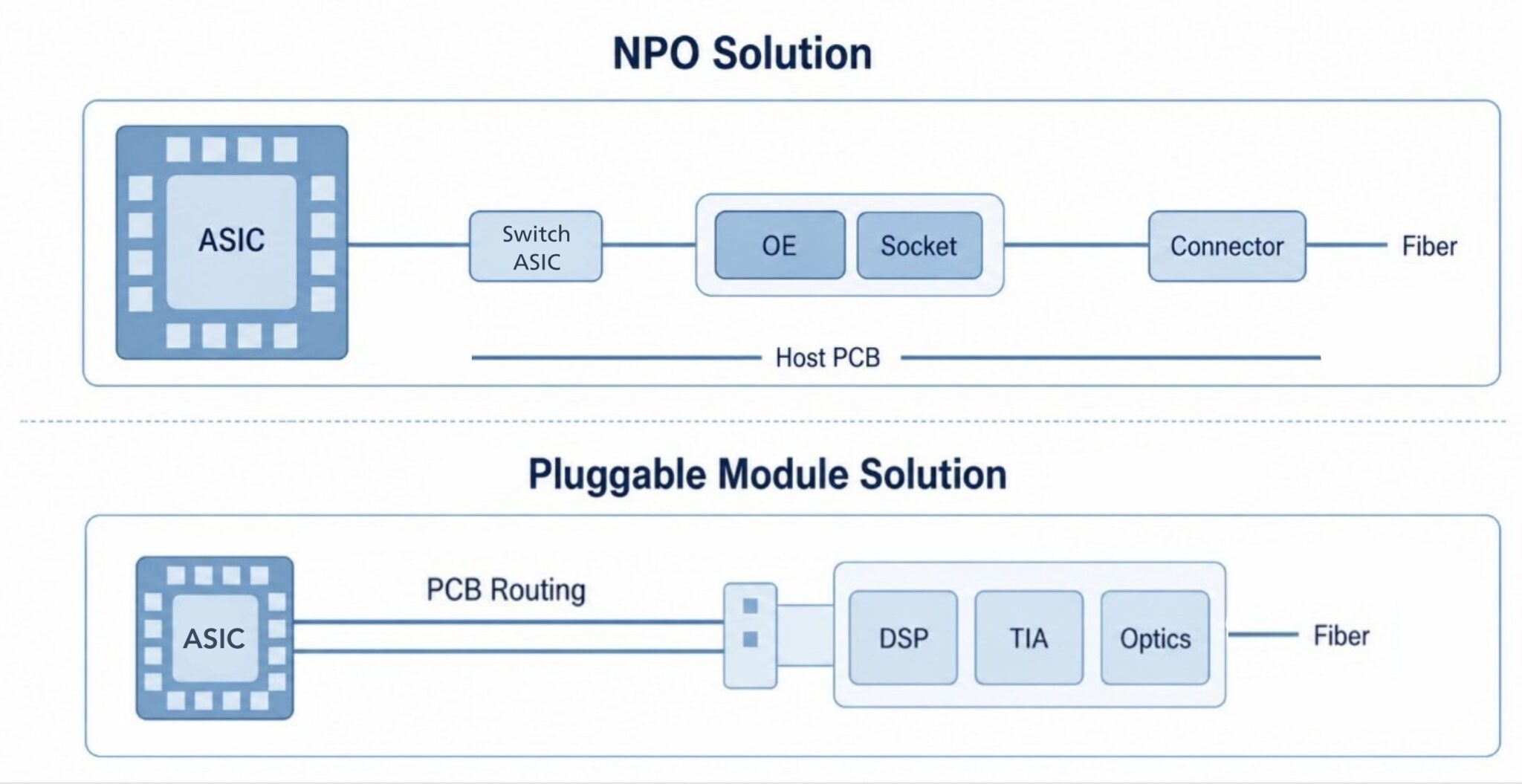
NPO repackages the core components from traditional modules into onboard Optical Engines, and optical fibers are routed out of the switch. The high-speed electrical connection distance is greatly shortened, and the dependency on DSP compensation is also reduced. However, NPO no longer belongs to the traditional hot-pluggable module category. It requires the entire switch PCB, power delivery, and thermal architecture to be redesigned.
CPO
CPO (Co-Packaged Optics) is an optical interconnect solution with a much higher integration level. NPO vs CPO, which only places the Optical Engine near the ASIC, CPO directly packages the optical devices and switch ASIC into the same package. This almost completely removes the signal loss problem caused by long PCB traces. So CPO is usually considered one of the key future directions for ultra-high-speed switching platforms.
CPO can achieve the best power efficiency, the highest system density, and the strongest signal integrity currently available. However, it is also the solution with the highest engineering complexity today. If the optical part fails, maintenance difficulty will also be much greater than traditional pluggable structures. Therefore, although many vendors are actively promoting CPO, the entire industry is still in the exploration stage.
What are the differences?
LRO/LPO vs CPO/NPO
| LPO / LRO | NPO / CPO | |
|---|---|---|
| Main Optimization | DSP architecture | Electrical path distance |
| Module Structure | Pluggable | Near-package / Co-package |
| Deployment Difficulty | Lower | Higher |
| System Change | Small | Large |
| Maintenance | Easier | More complex |
LPO and LRO are still essentially part of the traditional pluggable module ecosystem. They mainly optimize DSP architecture inside the module by reducing DSP participation to lower power consumption and latency. Therefore, their impact on existing switch architectures is relatively small, and they are easier to deploy quickly. NPO and CPO address the high-speed electrical connection problem between the ASIC and optical devices, which falls under a deeper level of system architecture upgrade. From a practical perspective, LPO and LRO are easier to deploy in current data centers. NPO and CPO are more focused on future AI high-speed switching platforms.
LRO vs LPO
| LPO | LRO | |
|---|---|---|
| DSP | Fully removed | Partially retained |
| Power Consumption | Lower | Medium |
| Latency | Lower | Low |
| Link Stability | Lower | Better |
| ASIC Dependency | Higher | Lower |
Both new solutions for saving power, LPO focuses more on achieving extremely low power consumption and low latency, so it completely removes the DSP. However, this also means the system depends heavily on the SerDes capability of the switch ASIC itself, and PCB design requirements become higher. LRO is more like a balanced solution. It keeps part of the DSP capability, so link stability, compatibility, and deployment difficulty are easier to control. For many current AI networking devices, LRO may actually be easier to implement and deploy than LPO.
CPO vs NPO
| NPO | CPO | |
|---|---|---|
| Optical Engine Position | Near ASIC | Inside ASIC package |
| Integration Level | High | Extremely high |
| Thermal Difficulty | Moderate | Very high |
| Maintainability | Better | Harder |
| Engineering Complexity | Medium | Highest |
Another approach for shortening trace runs, CPO requires a complete change to switch packaging architecture and pushes thermal design complexity to a very high level. Although NPO also changes the internal switch structure, it still keeps an independent optical engine design, so many vendors actually see NPO as a more practical direction. NPO vs CPO, which fully reconstructs the existing network architecture, NPO is more like a gradual upgrade path. For a long period in the future, NPO will likely enter large-scale deployment earlier than CPO.
How do you choose them?
Maintaining Existing Architecture
For users who do not want to change the current system architecture, choosing between LRO and LPO is a good option.
- For short-distance AI GPU Fabric environments, LPO is usually a very suitable solution. It can significantly reduce power consumption and latency, making it very suitable for high-speed interconnects inside large-scale AI training networks. However, these environments usually require the switch ASIC to have very strong SerDes capability.
- If the system wants to reduce power consumption but does not want to completely lose the stability and compatibility brought by DSP, then LRO vs LPO, LRO is a more balanced choice. Especially in many current 800G AI networking environments, both LRO and LPO may be suitable, and the final choice depends more on switch platform capability and deployment cost.
Rebuilding the System
If you are troubled by long PCB traces between optical devices and the switch ASIC, and have already decided to significantly change the current network architecture, then you can choose between NPO and CPO.
- For next-generation 1.6T switching platforms, as a practical solution for shortening signal paths, NPO will become increasingly important.
- CPO is better suited to future ultra-high-density, ultra-high-bandwidth, and ultra-low-power environments,Especially in future TB/s-level AI interconnects. However, it still faces maintenance and supply chain complexity problems, so it will still take time before full large-scale adoption becomes reality.
In many situations, these solutions will not completely replace each other. For example, future data centers will likely contain LPO, LRO, NPO, and CPO at the same time. Different switch layers, different network scales, and different deployment cost requirements will all affect the final selection. At the same time, OPTCORE stays up to date with the latest technological innovations in the optical devices industry and provides high-quality products and stable services.
-
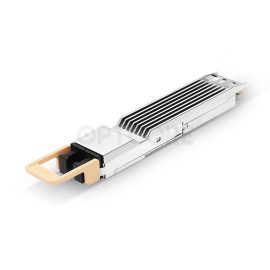
Generic OSFP-800G-DR8 Compatible 800G 2xDR4/DR8 OSFP Finned Top 1310nm 500m Dual MPO-12/APC Transceiver
US$ 899.00 (Excl. VAT) -
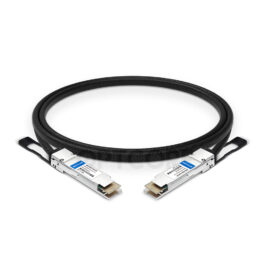
0.5~2m Generic QDD-800G-DAC Compatible 800G QSFP-DD DAC Cable
Price range: US$ 119.00 through US$ 199.00 (Excl. VAT) -
0.5~2m Generic OSFP-800G-DAC Compatible 800G OSFP Finned Top DAC Cable
Price range: US$ 99.00 through US$ 159.00 (Excl. VAT) -
Generic QSFPDD-400G-SR8 Compatible 400GBASE-SR8 QSFP-DD 850nm 100m Transceiver
US$ 139.00 (Excl. VAT)
FAQ
#1 Is LPO replacing traditional DSP optics?
No. Traditional DSP optics still have better compatibility and stronger signal recovery ability most of the time.
#2 Is LRO better than LPO?
Not completely. LRO vs LPO, LRO can provide a more practical solution, while LPO offers lower power consumption and lower latency.
#3 Does NPO still use optical modules?
Yes. NPO still uses optical components. They are just repackaged into onboard optical engines.
#4 Why is CPO considered difficult to deploy?
CPO requires deep integration between the optical engine and ASIC package. This greatly increases thermal management.
#5 Which technology is most suitable for AI data centers?
LPO and LRO are more realistic for large-scale deployment, while NPO and CPO are becoming important directions for next-generation AI switching platforms.
#6 Will pluggable optics disappear in the future?
Not soon. Traditional pluggable optics still offer excellent flexibility and maintainability.
Conclusion
Different emerging packaging architectures all represent the rapid development of the optical communication industry and the continuous effort to break through technical bottlenecks. Although LPO vs LRO vs CPO vs NPO all belong to high-speed optical interconnect technologies, each module and optical architecture has its own unique role. Understanding their characteristics is very important for making the correct choice for future network upgrades and expansion.
Read more
- What is the LRO Transceiver? The Simple Guide to Linear Receive Optics
- What is an LPO Transceiver? A Beginner’s Guide to Linear-drive Pluggable Optics
- Scale-Up vs. Scale-Out vs Scale-Across: What Are the Differences For AI Infrastructure
