


 Optical Transceiver
 DAC/AOC Cable
 Fiber Cabling
 Networking
Blog, Networking Device
Industrial vs Commercial Media Converter: What the Differences Are & When to Use Each
May
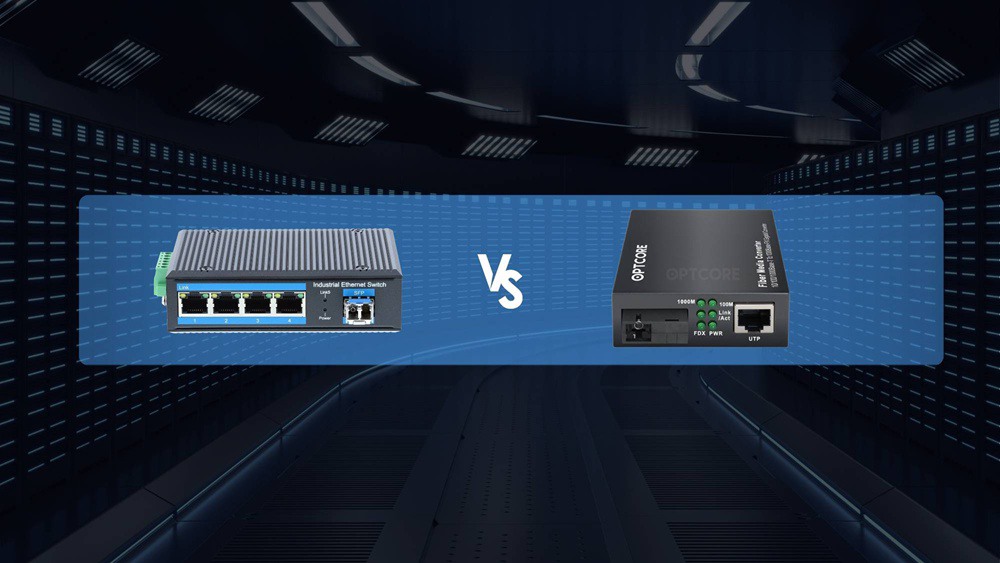
Industrial vs. Commercial Media Converters: These products are highly consistent in their core functions; both can convert copper wire to fiber-optic signals. So, what are the differences? Which one should be chosen among particular items? This article helps compare them in three dimensions: definitions, key differences, and application scenes to help readers make accurate judgments at the time of selection.
Table of contents
What is a commercial media converter?
The commercial media converter is used in companies’ offices, data centers, retail stores, and homes.
Typical features of commercial-grade products include the following: the operating temperature range is generally limited to 0 to 40 degrees Celsius or slightly wider; the operating voltage is typically a single low-voltage direct current input (e.g., 5 V or 12 V); the housing often employs plastic or ordinary metal material; and the heat radiation system is mainly free air convection or a small fan.
The installation method offers both desktop and easy rack installation options, and there is no need to consider structural reinforcement for an industrial-class product. The failure detection mechanism of commercial-grade products is relatively basic, primarily providing a link-state indication via an LED lamp, and lacks high-quality diagnostic functions such as link failure (LFP) and far-end fault detection (FEF) commonly found in industrial-grade products.
Commercial media converters need to point out that they are fully qualified within their scope. In a room with a constant temperature, low electromagnetic interference, and clean air, the business-class product can meet the needs of conventional optical fiber access and distance expansion at low cost without incurring unnecessary environmental resistance costs.
What is an industrial media converter?
An industrial media converter is a network transmission device designed for poor working environments.
From a product perspective, industrial-grade media converters typically use metal housings (often aluminum alloys) and offer protection ratings ranging from IP30 to IP40; in some specialized applications, the protection rating is higher. The mounting method is primarily DIN rail, and it is compatible with rack-mount installations, making it easy to integrate into the factory control cabinet. In the heat-radiation design, the industrial-grade product does not use a fan; the casing is passively cooled, avoiding mechanical failure caused by motion in harsh environments and preventing external dust from being drawn into the equipment.
In terms of core performance indicators, the operating temperature range of the industrial-grade media converter typically spans -40 to 75°C, and some specially reinforced products can cover an extreme range of -40 to 85°C. The voltage input supports a wide range of 12 to 48 VDC, with a double-redundant power supply. If one power supply fails, the other can seamlessly take over and keep the network running. Moreover, the industrial-grade product offers lightning and surge protection exceeding 4 kV, effectively protecting the equipment itself and other connected facilities on the network during lightning strikes and power grid fluctuations.
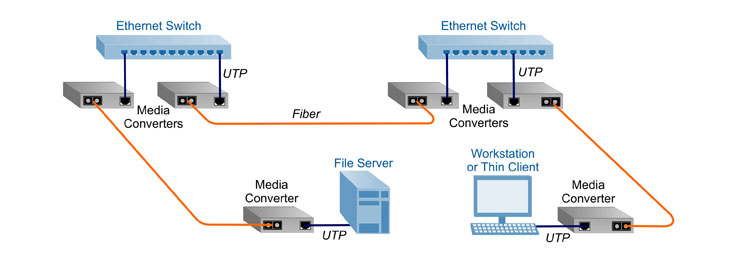
Figure 1: Ethernet Media Converters
Industrial vs commercial media converter: what are the differences?
The fundamental difference between the two types of media converters lies not in their functionality but in their design philosophy: the industrial class prioritizes “stability and resistance” and pursues sustainable, reliable operation under various uncertain conditions. Specifically, the differences between the two are shown in the following several dimensions:
| Comparison | Industrial Media Converter | Commercial Media Converter |
| Working temperature | -40℃ to 75℃ (some can reach 85℃) | 0°C to 40°C |
| Protection level | Standard with dual-redundant power inputs, enabling seamless switching in the event of a fault. | No clear requirement for a protection level, and most of them are open structures |
| Cooling method | Fanless, passive cooling by the shell | Free air convection, or active cooling by a small fan |
| The installation method | Mainly DIN rail installation, supporting rack-mounted | Desktop placement and simple rack installation |
| Power input | A wide voltage range of 12 to 48VDC, supporting reverse polarity protection | A single low-voltage DC input (such as 5V or 12V) |
| Redundant power supply | standard with dual-redundant power inputs, allowing seamless switching in case of a fault. | Typically a single power input with no redundancy design |
| Lightning surge protection | Not less than 4 kV | basic protection or no special reinforcement |
| The mean time between failures (MTBF) | Meets basic civil electromagnetic compatibility standards such as FCC and CE | Typically around 100,000 hours |
| The product lifecycle | 5 to 10 years with a long-term supply guarantee, slow iteration | Fast iteration cycle, and may face production stoppage after a few years |
| The fault detection function | Standard with dual-redundant power inputs, enabling seamless switching in the event of a fault. | With LED indicator lights indicating the link status |
| The initial procurement cost | Relatively high | Low |
Environment adaptability
This is the most intuitive and decisive difference between the two. The industrial-class media converter operates normally within the range of -40°C to 75°C and can withstand relative humidity above 99% while maintaining structural stability and electrical connectivity under sustained vibration and impact. In contrast, business-class products usually operate only within the normal temperature range of 0 to 45 degrees Celsius and are installed in environments without factory workshops, outdoor cabinets, or temperature-control facilities, resulting in hang-ups, restarts, frequent data loss, and permanent failures.
Protection level and interference ability
Industrial-grade products generally achieve IP30 to IP40 protection, meaning the outer shell can prevent the intrusion of solid foreign particles exceeding 2.5 mm (IP30) or 1 mm (IP40) and provides some protection against falling water droplets. Some specialized products reach the IP67 level and can withstand complete dust and brief flooding. Business-class products only meet consumer electromagnetic compatibility requirements, such as the basic FCC and CE requirements.
Power supply design and redundant mechanism
Industrial-grade media converters typically employ wide-voltage direct current input designs (e.g., 12 to 48 VDC) to accommodate voltage fluctuations and unstable power supply conditions commonly encountered in industrial environments. More importantly, most industrial products are equipped with a dual-redundant power supply, while the other circuit is fully functional. The other circuit has reverse-polarity protection to maintain the device’s normal operation. Business-class products have many single power sources and are highly dependent on voltage stability.
Reliability and life cycle
All core components of the industrial-class product are selected based on industry standards, and the average failure interval (MTBF) is much higher than for commercial-grade products—the MTBF of a good industrial-class converter can exceed 200000 hours, and commercial-grade products typically reach only 100000 hours.
Heat radiation system
The industrial-class product adopts a non-fan-case heat radiation design, and business-class products have a small fan, which reduces the risk of failure due to damaged fan parts; however, the failure probability may increase when fan and bearing wear accumulates after prolonged operation. Industrial-class products usually provide product life-cycle guarantees and long-term supply commitments of 5 to 10 years, while commercial-class products may have a repetitive cycle and face production shutdowns and parts shortages in a few years.
Industry certifications
An industrial-grade media converter must obtain a series of rigorous industry certifications to meet specific requirements. For example, the electric power industry substation scene requirements conform to the IEC 61850-3 and IEEE 1613 standards; rail applications need to meet the EN 50155 standards; and in the hazardous environment of oil and chemical industries, ATEX must be met with the NEMA TS-1 / TS-2 standards, where the ATEX explosion-proof and IECEx certifications are required. Business-class products typically have only basic certifications, such as FCC and CE, and the certification thresholds are relatively low.
Cost and ROI
Initial purchase costs for industrial media converters are clearly higher than those of commercial products. However, the cost contrast between the two is not based only on the unit price. Commercial-class products introduced into industrial settings often fail due to environmental mismatches—indirect costs such as production line stops, repairs, and equipment replacements far outweigh the price difference between industrial- and commercial-grade products. Therefore, for industrial applications, selecting industrial-class products is an economic decision that provides long-term reliability in exchange for initial investment.
When to choose an industrial media converter
If any of the following conditions are met, the industrial-class media converter must be selected.
- The equipment is placed in a non-temperature-controlled environment. If you need to install a media converter in an area where temperatures fluctuate, such as an outdoor cabinet, an unair-conditioned factory, a mine, a wind power tower, or a roadside, a commercial product is not suitable.
- Strong electromagnetic interference exists. At manufacturing sites, substations, mines, and welding stations, significant electromagnetic and radio-frequency interference occurs during the operation of large equipment. The transmission of industrial media converters and optical fibers can eliminate the impact of such interference on communication quality.
- The power supply environment is unstable. The quality of power networks in the industrial sector is less stable than in data centers. An extensive input voltage range and a dual-redundant power-supply design, supported by industrial-grade components, can ensure continuous operation of the equipment under such power-supply conditions.
- Relating to safety or production continuity. In scenes such as oil and natural gas platforms, chemical industry equipment, sewage treatment plants, and orbital traffic signal systems, communication interruptions may directly cause safety accidents and serious economic losses. Such a mission-critical application requires an industry-grade device to support full-state monitoring and obstacle warning.
- Industry compliance requirements must be met. In some industries, such as power, rail, and petrochemical, it has become clear that network devices, such as those compliant with IEC 61850-3 and ATEX, must obtain industry certification. In this case, choosing an industry-level product is not an option; it is an essential requirement for compliance.
When to choose a commercial media converter
A commercial media converter is suitable for cost-sensitive environments with specific conditions. Specifically, if you are eligible to select a business-class product.
- Network inside the standard office and office building: ambient temperature and humidity remain constant for many years, and there is no dust or vibration.
- The optical fiber inside the data center’s machine room is interconnected with the copper wire, and the mechanical chamber itself has full air conditioning and a dust removal system.
- Retail or small-store POS system and basic monitoring network connection requirements.
- Network home or small office (SoHo) optical fiber to your desktop.
- Laboratory test environment or non-real-time, non-critical temporary data collection project.
Recommended products
-
10/100/1000Base-T RJ45 to 1000Base-BX 20km Single Fiber WDM Media Converter (SC/ST/FC)
Price range: US$ 15.00 through US$ 16.00 (Excl. VAT) -
10/100/1000Base-T RJ45 to 1000Base-BX 40km Single Fiber WDM Media Converter (SC/ST/FC)
US$ 19.50 (Excl. VAT) -
10/100/1000Base-T RJ45 to 1000Base-BX 80km Single Fiber WDM Media Converter (SC/ST/FC)
US$ 31.00 (Excl. VAT) -
10/100/1000Base-T RJ45 to 1000Base-EX Singlemode 40km Fiber Media Converter (SC/ST/FC)
US$ 19.90 (Excl. VAT)
Conclusion
There are some distinctions between industrial vs. commercial media converters. For communication components and system integrators, accurate positioning of the two product types can not only help customers make the best choice but also help avoid network failures and maintenance costs due to mismatches between equipment and environments.
Read more
- What Is PoE Media Converter: A Complete Guide (2026)
- SAN Switch vs LAN Switch: What the Differences Are & When to Use Each
- FBT Splitter vs. PLC Splitter Comparison: What is the difference? (2026)
