


 Optical Transceiver
 DAC/AOC Cable
 Fiber Cabling
 Networking
Blog, Networking Device
SAN Switch vs LAN Switch: What the Differences Are & When to Use Each
May
In network infrastructure planning, the choice of switches directly affects the performance and reliability of business systems. The topic of SAN vs. LAN switches is increasingly being discussed. The storage area network (SAN) switch and local area network (LAN) switches are collectively referred to as switches, but they differ in design goals, operational methods, and technical characteristics. This passage analyzes the core differences between the two types of switches and offers an optional suggestion to help inform decision-making.
Table of contents
What is a SAN switch?
The SAN switch is a dedicated network device for area networks, and its core functions are to build high-speed data transmission channels between servers and shared storage devices and to transport storage traffic. The SAN switch allows network administrators to build large, high-speed storage networks and connect thousands of servers to a PB-level storage resource.
A SAN switch can be implemented using a Fiber Channel or Ethernet protocol, and the FC switch is the most common. The FC switch is compatible with the FC protocol designed for dedicated storage area networks. It provides guidance and management of data traffic between servers and storage devices to achieve fast data transfer and low-latency network performance.
FC switches function as intermediaries between servers and storage devices in the network. In the SAN environment, the server does not need to be directly connected to each storage device; it connects to the FC switch via a physical link, and the storage device is also connected to the switch. If the server needs to access the storage device, the exchange opportunity transfers the request to the corresponding storage device. The core advantage of the SAN switch is that there is no need to establish a dedicated connection between each server and each SAN storage device, reducing the complexity of the introduction.
What is a LAN switch?
A LAN switch is a core device for data exchange in a local area network (LAN). In a switch-type LAN, all sites are connected to a LAN switch that transfers data without conflict, such as via dedicated communication channels, and multiple ports can be connected simultaneously as required.
LAN switches are usually called Ethernet switches because they operate on the Ethernet protocol. As a hub for the local area network, it connects various devices, such as computers, servers, printers, cameras, and wireless access points, and intelligently forwards data frames to the appropriate destination port based on the MAC address.
There are various types of LAN switches that can be divided into layer 2 switches (based on MAC address transfer) and layer 3 switches (supporting IP routing functions) according to their operating levels and can be classified into fixed port types, stack types, and frame types depending on the form of the product, which can be divided into managed and unmanaged types by management. In terms of speed, the current LAN switch offers a wide range, from 1 GbE to 400 GbE.
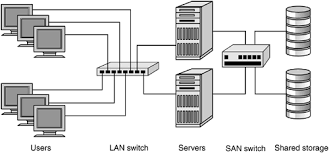
Figure 1: LAN switch and SAN switch (source from Google)
SAN vs. LAN switch: the differences between them
The following provides detailed explanations across several critical dimensions.
| SAN Switch | LAN Switch | |
| Main protocol | Fiber Channel Protocol | Ethernet Protocol (TCP/IP) |
| OSI working hierarchy | Layer 2-3 (FC layer) | Layer 2 or 3 |
| Design Objective | Dedicated to storing traffic, ensuring data integrity, and deterministic performance | Universal network connectivity to meet diverse communication needs |
| transmission characteristics | Non-destructive transmission, credit-based flow control mechanism | Best-effort transmission, possible packet loss |
| delay | Extremely low (nanosecond level) | Relatively high (microsecond to millisecond level) |
| reliability | High availability, supporting path redundancy | Dependency protocol level guarantees (such as STP and LACP) |
| Transmission unit | Fiber Channel frame | Ethernet frame |
| Connection medium | Fiber optics is the main component | Copper cables and optical fibers |
| Port speed | 32Gbps, 64Gbps, 128Gbps | 1Gbps to 400Gbps |
| Topological structure | Switched Fabric | Star-shaped, tree-shaped, mesh-shaped |
| Cost | Expensive and complex to deploy | Economical and easy to deploy |
| Management complexity | High, requiring professional SAN management skills | relatively low |
| Core application | Storage network, database, disaster recovery | Office network, park network, data center IP network |
Protocol and transmission characteristics. This is the fundamental difference between the two. LAN switches use the TCP/IP Ethernet protocol stack, operate based on the IP protocol, and achieve end-to-end communication using IP addresses and MAC addresses. It is a universal data transmission channel. SAN switches (especially FC switches) use the Fiber Channel protocol, which is a transport protocol designed specifically for storage workloads.
Performance and latency. SAN switches are purpose-built for storage traffic, delivering exceptionally low nanosecond switching latency. In contrast, modern LAN switches, while high-performing, typically experience microsecond-to-millisecond latency due to TCP/IP protocol overhead and the general network architecture. Furthermore, SAN switches’ lossless transmission ensures that storage I/O is never dropped during congestion, which is crucial for mission-critical applications such as databases and online transaction processing.
Reliability and redundancy design. SAN switches prioritize high availability in their design. They provided path redundancy and automatically switched to a backup path when a path failed. By employing a Fabric architecture for full-mesh connectivity, SANs ensure that no single failure disrupts storage network operations. LAN switches support redundant technologies such as Link Aggregation Control Protocol (LACP), Spanning Tree Protocol (STP/RSTP), and stacking, but these safeguards are primarily implemented at the protocol level, rather than being intrinsic to hardware and architecture.
Topology and scalability. LAN switches often use star, tree, or leaf-spine topologies, expanding networks by cascading switches. SAN switches use a switched Fabric topology, linking FC devices with FC switches and supporting point-to-point and switched Fabric modes. This architecture enables scalable interconnection of thousands of servers and storage ports.
Cost and deployment complexity. LAN switches offer high cost-effectiveness and ease of configuration, with a wide range of products available, from unmanaged switches costing tens of dollars to enterprise-level switches costing thousands. Users can choose according to their needs. SAN switches are significantly more expensive due to dedicated hardware and professional software, and deployment and management require specialized SAN management skills. However, in scenarios with strict requirements for performance, reliability, and data integrity, this additional investment is completely worth it.
When to choose SAN switch?
- Enterprise-level data center core storage network. When enterprises need to build a centralized storage architecture and decouple storage resources from servers to achieve unified management and efficient sharing, SAN switches are indispensable infrastructure components. The servers can share access to the same storage pool, achieving flexible allocation and efficient utilization of storage resources.
- High-performance databases and online transaction processing. OLTP applications such as financial trading systems, ERP systems, and e-commerce platforms have extremely high requirements for storage I/O latency and reliability. The lossless, low-latency data transmission capabilities provided by SAN switches ensure stable read and write performance for these critical applications.
- Applications such as data mining, data warehousing, and business analysis require frequent processing of massive amounts of data, which demands extremely high storage throughput capabilities. FC switches support high-speed ports of 32 Gbps, 64 Gbps, and even 128 Gbps, effectively meeting the needs of such workloads.
- Disaster recovery and business continuity. SAN switches support the construction of cross-site storage replication and disaster recovery architectures. Using FC expansion technology, synchronous or asynchronous data replication between data centers can be achieved, providing strong business continuity.
- Workloads and enterprise AI. As enterprises begin deploying AI inference workloads in their own data centers, storage networks need to deliver high throughput, extremely low latency, and strict performance isolation.
Recommended products
-

Brocade XBR-000212 XBR-000213 Compatible 32G Fibre Channel SFP28 850nm 100m Transceiver
US$ 79.00 (Excl. VAT) -
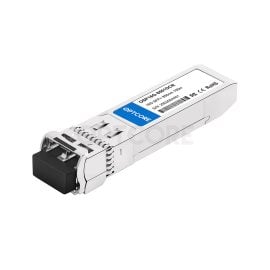
Avago AFBR-57F5MZ-ELX Compatible 16G Fibre Channel SFP+ 850nm 100m Transceiver
US$ 49.00 (Excl. VAT) -
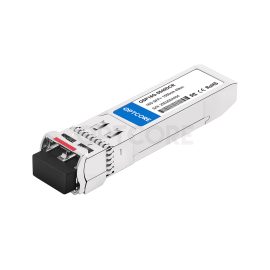
Brocade 57-1000262-01 XBR-000258 Compatible 16G Fibre Channel SFP+ 1550nm 40km Transceiver
US$ 359.00 (Excl. VAT) -
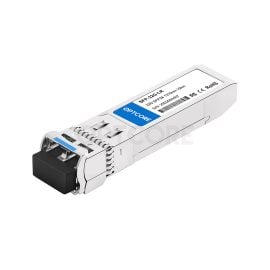
Brocade XBR-000238 XBR-000239 Compatible 32G Fibre Channel SFP28 1310nm 10km Transceiver
US$ 199.00 (Excl. VAT)
When to choose LAN switch?
- Enterprise office network. Connect employee computers, printers, IP phones, and other office equipment to provide the infrastructure for daily network communication. This is the most common use case for LAN switches. Through VLAN partitioning, traffic from different departments or functions can be securely isolated.
- Park network and campus network. LAN switches are the core equipment for building stable and secure wired networks in large park environments such as schools, hospitals, and government agencies.
- Data center IP network. In the inter-server communication network (i.e., the business network) within the data center, LAN switches carry application traffic, east-west traffic, and external service traffic. At this point, high-density 25GbE/100GbE/400GbE switches are typically used to build a leaf-spine topology for maximum bandwidth and scalability.
- Network feedback. Modern enterprises widely deploy Wi-Fi 6/7 wireless networks, and many wireless access points need to transmit data back through wired networks. LAN switches that support PoE can provide both network connectivity and power to APs, simplifying deployment.
- Small and medium-sized enterprise network. For smaller enterprises, one or several gigabit LAN switches can meet all network requirements, support basic functions such as file sharing, print services, Internet access, etc., and are low-cost and easy to maintain.
- Video surveillance and Internet of Things integration. IoT devices such as IP cameras, access control systems, and environmental sensors are typically connected to the network through LAN switches. PoE switches are particularly important in this scenario, as they can simultaneously power and transmit data to cameras through Ethernet cables.
Recommended products
-

Alcatel-Lucent QSFP28-100G-LR4 Compatible 100GBASE-LR4 QSFP28 1310nm 10km Transceiver
US$ 169.00 (Excl. VAT) -
Allied Telesis AT-QSFP28-LR4 Compatible 100GBASE-LR4 QSFP28 1310nm 10km Transceiver
US$ 169.00 (Excl. VAT) -
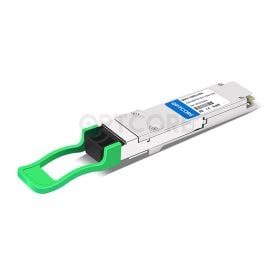
Arista QSFP-100G-CWDM4 Compatible 100GBASE CWDM4 Lite QSFP28 2km Transceiver
US$ 99.00 (Excl. VAT) -

Allied Telesis AT-QSFP28-SR4 Compatible 100GBASE-SR4 QSFP28 850nm 100m Transceiver
US$ 29.90 (Excl. VAT)
Conclusion
Although SAN switches and LAN switches share similar names, they operate at different network layers and serve different business needs. LAN switches are a universal network infrastructure that connects people and applications, prioritizing flexibility, coverage, and cost-effectiveness; SAN switches are dedicated storage channels that ensure efficient and secure data flow, prioritizing determinism, losslessness, and extremely low latency.
In practical network planning, SAN vs. LAN switches often coexist. Understanding the difference between the two can help communication accessory and network equipment purchasers provide customers with more accurate selection recommendations, thereby finding the best balance between cost, performance, and reliability.
Read more
- What Is a Multi-Gigabit Switch: Features & Top Picks
- Best 2.5G Ethernet Switch Guide: Unlock The Multi-Gig Connectivity
- What is Virtual LAN (VLAN)? A Complete Guide
