


 Optical Transceiver
 DAC/AOC Cable
 Fiber Cabling
 Networking
Blog, Optical Transceiver
What is an XPO Transceiver? A Beginner’s Guide to eXtra-dense Pluggable Optics
Jun
AI clusters are developing rapidly. Modern optical transceiver development has already introduced many different approaches aimed at increasing the upper limit of network deployment. For example, LPO (Linear Pluggable Optics) and LRO (Linear Receive Optics) focus on reducing power consumption. While NPO (Near-Packaged Optics) and CPO (Co-Packaged Optics) focus on improving signal quality and system stability. All of these technologies attempt to solve the challenges faced by future AI infrastructure from different perspectives. XPO Transceiver is also one of the approaches for pushing deployment limits further.
XPO (eXtra-dense Pluggable Optics) represents another technology path. It aims to achieve bandwidth density and system efficiency while retaining the maintainability and replaceability of traditional pluggable optical modules. For AI data centers that are concerned with deployment cost, operational efficiency, and upgrade flexibility, XPO is becoming one of the new directions attracting industry attention. This article will provide a detailed introduction to this technology.
Table of contents
Port Density Defines the Upper Limit
Over the past decade, improvements in data center network performance have mainly relied on increasing single-port speeds. From 10G to 40G, then to 100G, 400G, and 800G, each generation of switch chips has improved interface bandwidth through faster SerDes technology. However, simply increasing port speed is no longer enough to solve system-level scaling challenges.
Taking current mainstream switching platforms as an example, a 51.2Tbps switch ASIC is typically paired with 64 800G OSFP ports. As switch ASICs continue to evolve toward 102.4 Tbps or even 204.8 Tbps. It becomes increasingly difficult to add more ports to the front panel. Even if the switch chip offers higher bandwidth, the front panel may not have enough physical interfaces to fully utilize it.
Data center networks may need to add additional switching layers over time, so a two-layer Clos network could evolve into a three- or even four-layer architecture as network demands grow. As network layers increase, the number of links also increases, which raises the probability of failures.
At the same time, AI servers themselves are rapidly moving toward liquid cooling. Mainstream AI rack power has already increased from 20kW to 60kW, 120kW, and even higher. In this environment, optical interconnect devices that still rely on air cooling can become the weakest point of the entire liquid-cooled system. XPO Transceiver, on the other hand, considers liquid cooling as part of the module architecture from the beginning. It enables optical modules to integrate directly into liquid-cooling infrastructure and fundamentally solve thermal challenges in ultra-high-density deployments.
What is XPO Transceiver
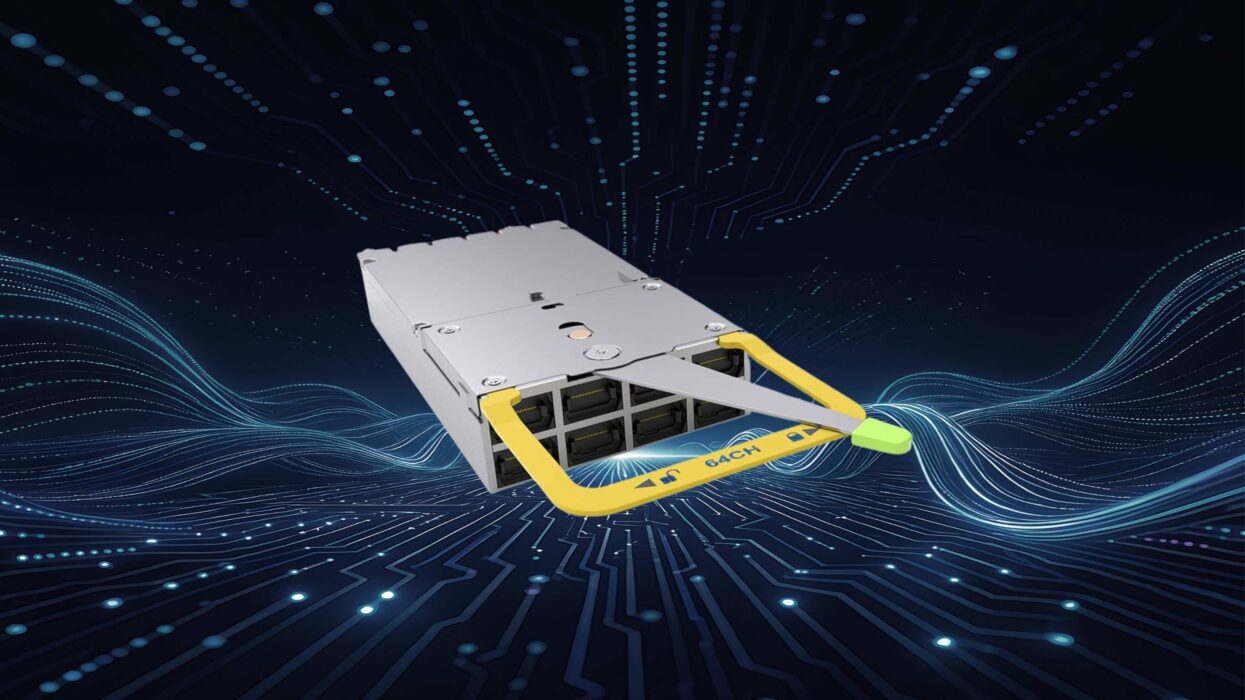
XPO (eXtra-dense Pluggable Optics) is a next-generation optical interconnect architecture concept introduced around OFC 2026. Unlike traditional pluggable optical modules such as OSFP and QSFP-DD, XPO is not simply focused on increasing lane speed or adding more ports. Instead, it redesigns the structure, power delivery, cooling system, and signal transmission architecture of optical modules from a system-level perspective. The design goal of XPO is to retain the maintainability advantages of traditional pluggable optics while achieving bandwidth density.
Belly-to-Belly Dual-PCB Architecture
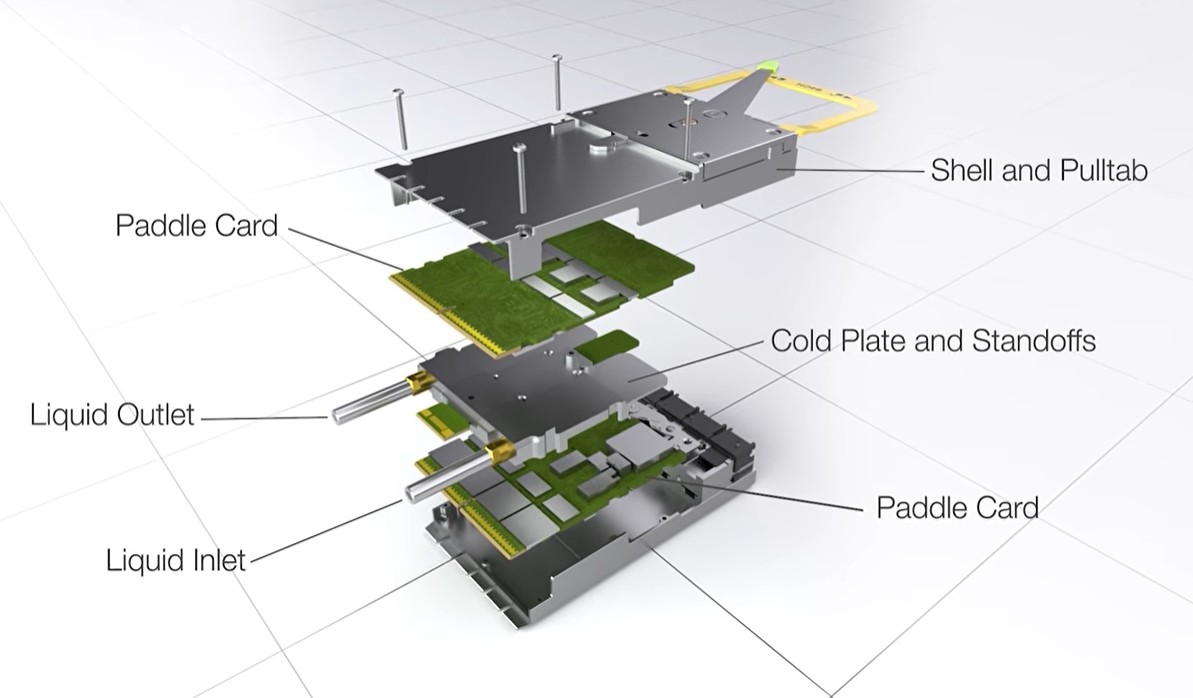
A key feature of XPO technology is its “Belly-to-Belly” architecture, which uses two independent 32-channel PCBs placed face-to-face inside the module, rather than the single-board approach typically seen in OSFP designs. Furthermore, there is an innovation related to the configuration of the arrangement of internal components. High-power components, such as laser drivers and transmitters, occupy space in the hot region, while components such as receivers, power management units, and control circuits are in the cold region.
Integrated Liquid Cooling Design
The new cooling method for XPO Transceiver directly integrates the liquid cooling unit into the optical module, eliminating the need for external cooling components in the switch. Specifically, the cold plate in the module is located between two PCBs so as to cool both sides simultaneously. In this way, heat will be conducted to the coolant along the shortest possible path. Liquid cooling systems are more efficient than traditional air-cooling systems, which use airflow to dissipate heat from devices. The XPO modules feature an integrated cold plate capable of cooling up to 400W per module.
Electrical Interface Optimization
In addition to enhancements in structural design and cooling, XPO introduces a redesigned electrical architecture. The XPO specification features a 64-lane electrical interface supporting a maximum rate of 224 Gbps per lane, typically operating at 200 Gbps per lane, enabling a total data rate of 12.8 Tbps per module. One of its key innovations is the use of a native liquid-cooled cold plate for advanced thermal management, supporting power dissipation levels beyond what conventional pluggable optics can handle.
Key Specifications of XPO Transceiver
- Single Module Bandwidth: 12.8 Tbps
- Electrical Channels: 64 × 200G PAM4
- Front Panel Density: 204.8 Tbps per 1OU
- Power Capability: >400W
- Cooling Method: Integrated Liquid Cooling
- Module Size: 60.8 mm × 111.8 mm × 21.3 mm
- Future Roadmap: 25.6 Tbps
XPO vs OSFP vs CPO
| OSFP | XPO | CPO | |
|---|---|---|---|
| Architecture | Traditional Pluggable Optics | eXtra-dense Pluggable Optics | Co-Packaged Optics |
| Serviceability | Hot-swappable | Hot-swappable | Limited Serviceability |
| Optical Engine Location | Inside Module | Inside Module | Integrated Near ASIC |
| Bandwidth per Module | Up to 1.6Tbps | 12.8Tbps or more | Depends on System Design |
| Front Panel Density | Standard | Ultra-high Density | Extremely High Density |
| Cooling Method | Air Cooling | Integrated Liquid Cooling | System-level Liquid Cooling |
| Power Supply | 3.3V DC | 46–53V DC | System-level Power Architecture |
| Thermal Capability | Moderate | >400W per Module | Very High |
| Deployment Complexity | Low | Medium | High |
| Maintenance Cost | Low | Medium | High |
| Flexibility | High | High | Low |
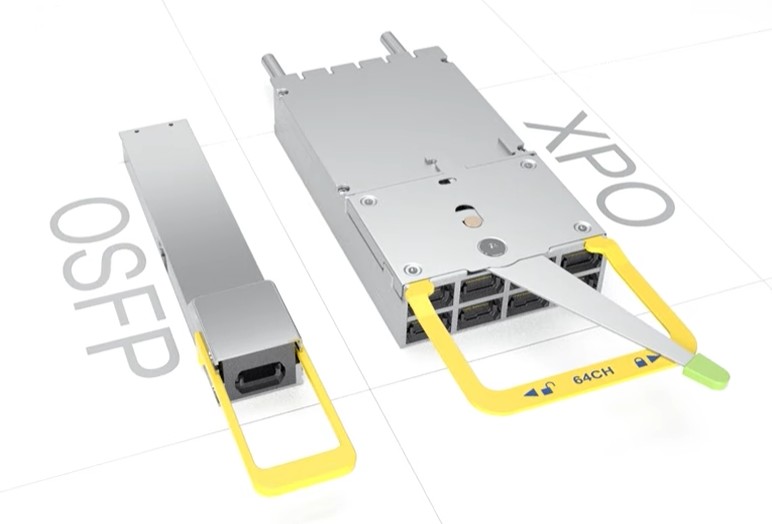
Traditional optical modules are valued for their maturity and cost-effectiveness, making them suitable for enterprise and telecommunications networks, as well as standard cloud data centers. CPO reduces the signal distance by placing the optical engine adjacent to the switch ASICs. From the theoretical point of view, it is possible to maximize efficiency. On the other hand, there are difficulties in manufacturing and maintaining CPOs. XPO offers a more realistic solution because the concept does not reject the modularity of optical engines. It tries to implement it in practice through liquid cooling, high voltage, and high density.
What Can XPO Transceiver Bring to Data Centers
Solving Front Panel Bandwidth Bottlenecks in AI Clusters
Given its 12.8Tbps per module bandwidth and 204.8Tbps/1OU density at the front panel, XPO Transceiver packs the switching capacity previously accommodated by multiple chassis modules into a significantly compact space. More ports per rack area can be offered using XPO technology. It will help accommodate the increasing number of ports needed for AI cluster deployment. In addition, XPO can achieve a bandwidth density up to 4 times that of traditional OSFP in the same cabinet footprint.
Reducing Network Layers in Large AI Fabrics
With growing numbers of AI clusters, the topological structure may be expanded from two layers to three or four Clos networks. Every time new layers are added to the network, the latency will be increased, and there will be new risks associated with more complexity and potential for failure. XPO was developed to enhance AI networking and metro reach fabrics, thereby increasing total bandwidth per switch.
The XPO technology is designed to support various AI networking architectures, which may enable some systems to reduce the number of Leaves, Spines, and potentially Super-Spines, thereby improving training efficiency. Additionally, using fewer devices overall can help lower the probability of failure.
Better Matching Liquid Cooling Infrastructure
In general, traditional OSFP networking components consume much lower power density than GPU servers. As a result, compute equipment may be fully liquid-cooled while network equipment still relies on air cooling. It creates uneven thermal distribution across the rack. XPO treats liquid cooling as a core architectural component from the outset, enabling network and compute devices to share a unified thermal management strategy and better utilize existing cooling resources.
Improving Power Allocation Efficiency Inside AI Racks
Modern AI data centers operate under fixed power budgets. Traditional data center power architectures using 12V and 48V rack systems at 50-54VDC have been optimized for stable power delivery to CPUs and storage, but the rise of powerful GPUs and AI accelerators is pushing power demands far beyond these designs.
The XPO solution is engineered specifically for AI networking and offers record-breaking throughput of 12.8 Tbps per pluggable module, along with unprecedented rack density of 204.8 Tbps per OCP rack unit, supporting more efficient and higher-density data center operations compared to previous lower-voltage systems. In fact, data centers can dedicate more of their power budget to computing infrastructure instead of networking.
At the same time, OPTCORE stays up to date with the latest technological innovations in the optical devices industry and provides high-quality products and stable services.
-
Generic OSFP-800G-DR8 Compatible 800G 2xDR4/DR8 OSFP Finned Top 1310nm 500m Dual MPO-12/APC Transceiver
US$ 899.00 (Excl. VAT) -
0.5~2m Generic QDD-800G-DAC Compatible 800G QSFP-DD DAC Cable
Price range: US$ 119.00 through US$ 199.00 (Excl. VAT) -
0.5~2m Generic OSFP-800G-DAC Compatible 800G OSFP Finned Top DAC Cable
Price range: US$ 99.00 through US$ 159.00 (Excl. VAT) -
Generic QSFPDD-400G-SR8 Compatible 400GBASE-SR8 QSFP-DD 850nm 100m Transceiver
US$ 139.00 (Excl. VAT)
FAQ
#1 Does XPO require specialized equipment for installation?
No. XPO maintains a pluggable architecture, and field replaceability remains one of its core design goals.
#2 How much bandwidth can a single XPO module provide?
Current designs target 12.8 Tbps, with future evolution planned toward 25.6 Tbps. The bandwidth is eight times that of standard OSFP
#3 Is XPO replacing OSFP?
Not immediately. XPO was developed specifically to support a range of AI networking needs, targeting future high-density AI deployments, while OSFP remains the mainstream solution for most current installations.
#4 Is XPO suitable for existing AI clusters?
Maybe. Future compatibility will depend on support for the switch and cooling platform.
#5 Is XPO the same as CPO?
No. XPO remains a pluggable architecture, while CPO integrates optical components directly with switch silicon.
#6 What problem is XPO trying to solve?
Its primary goal is to overcome bandwidth density, cooling, and power-delivery limitations faced by future AI infrastructure.
Conclusion
Next-generation AI infrastructure is shifting its focus from pure performance toward overall efficiency. As switch ASIC bandwidth continues to increase, port density, power delivery capability, and cooling performance are becoming new limiting factors. Through ultra-high-density channel design, an integrated liquid-cooling architecture, and a high-voltage power-delivery system, XPO Transceiver may help the optical communication industry overcome port-density challenges and provide a new approach to data center operations.
Read more
- What is NPO? The Simple Guide to Near-Packaged Optics
- What is the LRO Transceiver? The Simple Guide to Linear Receive Optics
- LPO vs LRO vs CPO vs NPO Optics: Understanding The Difference
