


 Optical Transceiver
 DAC/AOC Cable
 Fiber Cabling
 Networking
Blog, Networking Device
What is a WLAN Controller? The Simple Guide
May
Today, wireless networks are not rare in most places. When you’re walking around the office with your phone or laptop, you can automatically connect to the nearest Wi-Fi signal, so video conference calls won’t drop, go out of range, or go offline. Behind it is an important device: the WLAN controller. For practitioners, understanding WLAN controllers can help build more stable wireless networks. This article introduces the concept of a WLAN controller.
Table of contents
Definition of WLAN Controller
Architectures of Wireless Networks
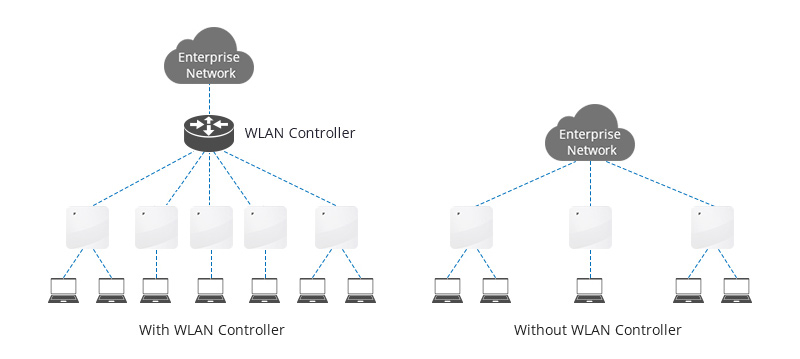
Before understanding the WLAN controller, you need to understand what the wireless access point (AP) is. Each AP is like a small, independent router. SSIDs, passwords, channels, and power settings must be configured individually to log in. It may be feasible for one person to manage fewer than 10 APIs. But when there are dozens to hundreds of APs, the workload becomes enormous. This makes it difficult to unify the strategy. Even more awkward is when the user walks between multiple APs. There is often a lack of coordination among the fat APs, and roaming is often offline with sticky signals.
Then the “thin AP + controller” architecture emerged. The thin AP itself is responsible for transmitting and receiving radio signals and has almost no administrative functions. All configurations, security rules, and radio-frequency policies are unified by the central WLAN controller. To simplify understanding, the AP is the executor, and the WLAN controller is the command center. This division makes it easy and efficient to manage large wireless networks.
Core Definition of WLAN Controller
The WLAN controller is a network device or software platform that centrally manages, controls, and optimizes multiple access points in a wireless network. Whether it is a hardware box or a virtual machine running on the server, it can still be a cloud service. Regardless of the form, the role of the WLAN controller is to make it easier to manage the entire wireless network as a single device by intelligently and cooperatively configuring many thin APs.
When an AP is online, the controller is automatically detected, and the latest configuration and firmware are downloaded. The client data is returned to the controller via the tunnel for central processing. This allows the network administrator to configure the controller only one time. At the same time, the configuration is automatically synchronized to all APs.
What Can a WLAN Controller Do?
Just using it to change the Wi-Fi name and password makes the controller too simple to operate. In fact, the functionality of the WLAN controller is much more useful than this and almost covers the operational dimension of the wireless network.
Lump Configuration and Lumping
If you add a new AP, simply connect the network cable and supply power; the configuration will be automatically delivered from the WLAN controller. It means you do not need to manually adjust the site. The plug-and-play features can save significant implementation time for large-scale introduction across hundreds of APS, such as logistics parks and schools.
Intelligent Radio Frequency Management
The WLAN controller can dynamically adjust each AP’s channel and transmit power to achieve automatic radio-frequency optimization. If an AP experiences overload or external interference increases, the controller can order the appropriate AP to expand its coverage range to prevent wireless service interruption.
Seamless Roaming and Load Balancing
When the user moves, the controller adjusts the client’s APs’ switching and supports quick, secure roaming to avoid reauthentication delays. At the same time, the controller monitors the number of client connections per AP. When an AP is overloaded, it connects the newly connected terminal to an adjacent AP with less load. This helps balance overall network pressure. This is important for high-density meeting rooms and other places with large numbers of people.
Security Policy and Entry Control
WLAN controllers are convergence and control points of all wireless traffic. WPA3 encryption, 802.1x enterprise authentication, guest isolation, illegal AP detection, and wireless intrusion protection can be implemented centrally. All client traffic passes through the controller. You can apply a security policy to all networks at once, without configuring firewall rules for each AP individually.
Application Recognition and Service Quality Assurance
Some latest WLAN controllers can identify thousands of network applications, such as voice, video conferencing, and enterprise ERP, and dynamically assign bandwidth and priority based on demand. This prevents important business from being affected by the usual intranet and improves the user experience.
Analysis of Spaces and Troubleshooting
A controller incorporating a space analysis function can continuously monitor the wireless environment and identify non-Wi-Fi interference sources such as microwave and Bluetooth devices. It provides the administrator with location-based reproduction and interference positioning to prevent network failures caused by non-Wi-Fi interference sources.
Three Common Forms of WLAN Controllers
With technological development, the WLAN controller has evolved into a variety of forms to accommodate different scales and budgets, rather than a single hardware box.
Local Hardware Controller
It is the most traditional type of network device deployed in corporate data centers and machine rooms. The advantages are high performance, stable transfer capability, and the ability to manage several tens of thousands of APs. In large parks, hospitals, and factories, this kind of hardware controller is mainstream. With such an introduction, the combination of a high-gain antenna and a low-loss feed line enables the AP, under the controller’s remote management, to cover more warehouses.
Virtualization Controller
It can install a software WLAN controller on a regular x86 server or a virtual machine to obtain the necessary computational and memory resources. But the functions are limited, not as much as local hardware controllers.
Cloud Management Controller
This is a mainstream trend in recent years. The control feature operates in the cloud, and the AP connects to the cloud platform via the Internet. Administrators can use web pages or apps to manage any site’s wireless network anywhere in the world. Cloud controllers are particularly suitable for chain stores, distributed offices, and limited organizations with limited IT personnel. Because there is no need to maintain the controller’s hardware locally, functions such as automatic upgrades and analysis reports are provided as a service.
Why You Need WLAN Controllers
Many small network administrators ask, “If I have only a small number of APs, do I still need a controller?” The answer is, yes. A WLAN controller is still necessary. If the business requires the next capability, it soon reveals the controller’s value. Integrated employee and guest access policies, business applications that don’t interrupt while moving, adding, or replacing APs quickly without affecting the entire network, and real-time visibility of wireless networks.
Some controllers have lightweight control logic, with the virtual controller function built into the AP, even with only 10 APs. An independent WLAN controller is almost essential when deployed across multiple floors or buildings with more than 20 APs. If you have a wireless coverage solution for your company, we recommend including a controller. Controllers can attach to switches or other equipment. If you want to attach the controller to the switch, SFP modules are useful. There are some recommended products for you.
Recommended products
-

Supermicro AOM-SFP28-25GBE-SR-1-MLN Compatible 25G SFP28 SR 850nm 100m Transceiver
US$ 15.00 (Excl. VAT) -

Brocade 25G-SFP28-LR Compatible 25G SFP28 1310nm 10km Transceiver
US$ 27.00 (Excl. VAT) -
Cisco SFP-25G-SR-S Compatible 25G SFP28 SR 850nm 100m Transceiver
US$ 15.00 (Excl. VAT) -
Juniper JNP-SFP-25G-SR Compatible 25G SFP28 SR 850nm 100m Transceiver
US$ 15.00 (Excl. VAT)
FAQs
Q: What’s the difference between a WLAN controller and a router in my home?
A: The router in your home can transmit a signal, while the WLAN controller itself cannot transmit a signal. It’s just for management.
Q: With a WLAN controller, will the signal become better on its own?
A: The controller will intelligently allocate channels, but it cannot violate the laws of physics. If the AP itself does not cover well, the antenna gain is insufficient, and the feeder attenuation is high, the signal should be weak.
Q: Can I mix different brands of APs and controllers?
A: Not very recommended. Although there is a unified standard protocol, each manufacturer has added their own optimizations, making it difficult to achieve comprehensive management across brands and greatly reducing functionality and stability. It is best to identify the same brand to ensure perfect compatibility with all functions.
Conclusion
A WLAN controller is a modern wireless network brain that integrates distributed access points into an intelligent, controllable network. It provides network automation, security protection, and seamless roaming capabilities. WLAN controllers serve organizations of different sizes in various forms, from desktop hardware to cloud services. I hope this guide helps you easily grasp the core concepts of WLAN controllers and make informed choices for practical projects.
Read more
- SAN Switch vs LAN Switch: What the Differences Are & When to Use Each
- Passive Optical LAN: A Beginner’s Guide
- What is Virtual LAN (VLAN)? A Complete Guide
