






Blog
What Is Optical Return Loss: A Beginner’s Guide

Mar
In a fiber optic link, the signals are supposed to travel one way, forward, but, like sound echoing off the walls of a room, part of the signal will bounce back when it encounters an interface. This does not necessarily mean the link will fail, but it will nonetheless affect the system’s stability. This is called optical return loss.
Optical Return loss is the parameter used to measure how serious the reflection is. The word “loss” sounds like something that should be as small as possible, but return loss works differently. In high-speed single-mode links, DWDM systems, and even certain high-power laser applications, reflection control directly affects bit-error rate and laser stability. It is not a secondary metric. It is part of the underlying physics of signal transmission. Understanding it is essential to understanding overall link quality.
Table of contents
What Is Optical Return Loss?
Optical Return loss is defined as the ratio of incident to reflected power, expressed in decibels.
Return loss = 10 × log(P_in / P_ref) dB
- P_in means Incident Optical Power
- P_ref means Reflected Optical Power
This equation shows that a smaller reflection means a larger value of optical return loss.
Let’s look at practical examples:
- If reflected power is 1% → RL ≈ 20 dB
- If reflected power is 0.01% → RL ≈ 40 dB
- If reflected power is 0.0001% → RL ≈ 60 dB
Every 20 dB increase roughly reduces reflection by a factor of 100.
Although the term includes “loss,” return loss does not describe how much energy disappears. It describes how much stronger the forward signal is compared to the reflected signal. In communication engineering, attenuation, gain, and reflection are expressed in dB because dB represents ratios, not absolute values. Engineers care about how many times stronger the forward signal is — not how many milliwatts the reflection contains.
Another method makes use of the reflection coefficient, Γ (Gamma):
Return Loss (dB) = -20 log₁₀ |Γ|
In the equation above, the reflection coefficient Γ refers to the ratio of the reflected electric fields to the incident electric fields. This expression is more common for RF systems, whereas in optical systems, power ratios are generally preferred.
Why and Where Optical Return Loss Matters
In fiber-optic short links, small levels of reflection may not always pose an immediate concern. However, in some situations, the effects of reflected signals become critical.
# Laser Stability
One concern with reflected signals in fiber-optic communication systems is the stability of the laser source.
When light waves reflect within the fiber optic cable, they may re-enter the laser source. This may interfere with the conditions within the source, leading to noise and mode hopping in some systems.
# Noise Accumulation
Another concern with reflected signals in fiber-optic communication systems is the buildup of noise.
In fiber-optic communication systems with multiple connectors and patch panels, each connector and patch panel may reflect some of the light. These reflected signals may individually have minimal effects. However, in aggregate, they may degrade signal quality.
# High-Speed Modulation Systems
One concern with reflected signals in fiber-optic communication systems is their effect on high-speed systems. In some high-speed fiber-optic systems, reflected signals may degrade signal quality. This may manifest in.
| Common Fiber Optic Systems | Return Loss Values |
| PC connector | 20–30 dB |
| UPC connector | ≥ 40 dB |
| APC connector | ≥ 60 dB |
| Fusion splice | ≥ 55 dB |
High-quality LC/APC patch cords and other components can significantly reduce back reflections and improve overall link stability.
Related Products
-
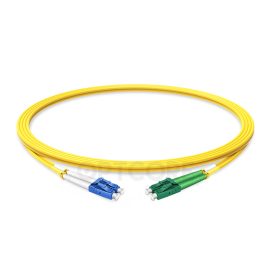
LC/UPC-LC/APC 9/125 OS2 Singlemode LSZH Duplex Fiber Patch Cable
Price range: US$ 2.80 through US$ 27.50 (Excl. VAT) -
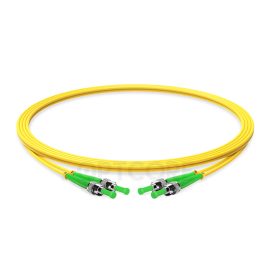
ST/APC-ST/APC 9/125 OS2 Singlemode LSZH Duplex Fiber Patch Cable
Price range: US$ 3.00 through US$ 27.70 (Excl. VAT) -
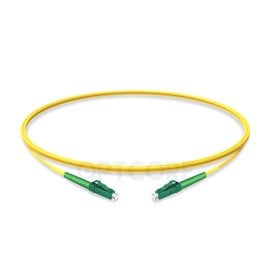
LC-LC APC 9/125 OS2 Singlemode LSZH Simplex Fiber Patch Cable
Price range: US$ 1.70 through US$ 6.20 (Excl. VAT) -
LC-LC 9/125 OS2 Singlemode LSZH Duplex Fiber Patch Cable
Price range: US$ 2.40 through US$ 27.50 (Excl. VAT)

APC connectors are commonly used in long-distance single-mode systems because their angled end face significantly reduces back reflection. In data center short-reach links, optical return loss is usually not the primary concern as long as the connector quality is good. However, it becomes critical in:
- Long-distance single-mode fiber systems
- DWDM transmission systems
- High-power laser systems
- Bidirectional systems
If you are wondering about the value of acceptable return loss, in fiber optics, it is set to at least 40 dB, while in more demanding environments, it is set to 50 dB or higher.
Insertion Loss vs. Return Loss
Optical Insertion loss is another key concept often mentioned. The two are related but measure completely different behaviors.
Insertion Loss (dB) = 10 × log₁₀ (P_in / P_out)
- P_in = input power
- P_out = output power
Since output power is usually lower than input power, insertion loss is a positive number representing signal attenuation. The difference between them is straightforward:
- Insertion loss describes forward signal reduction.
- Return loss describes the reflected signal ratio.
| / | Insertion Loss | Return Loss |
| Formula | 10 log(P_in / P_out) | 10 log(P_in / P_ref) |
| Measures | Forward attenuation | Back reflection |
| Higher is better? | No | Yes |

One measures how much signal leaks away. The other measures how much signal bounces back. Understanding the difference between them is important when evaluating fiber optic link performance.
How is Optical Return Loss Measured?
In practice, measuring optical return loss is less about the formula and more about understanding what is coming back from the link. In fiber optic systems, we usually rely on a few common approaches:
• OTDR
If the task at hand involves troubleshooting, then OTDR is usually the first device to turn to.
OTDR sends light pulses through the fiber and analyzes the reflected light at varying distances. This way, you can not only see the strength of the reflected light but can also pinpoint its location, whether it’s at a connector, a splice, or a damage spot.
• Optical Return Loss Meter
If you’re more concerned with the fiber-optic link’s actual return loss rather than the location of the reflected light, then using a return loss meter is simpler.
This device simply shines a constant light through the fiber and measures the reflected light. The actual calculation of the return loss figure is done within the device. This method is perhaps the easiest for end-to-end measurement of a fiber optic link.
• Light Source + Power Meter
In a laboratory setting, the reflected and incident light can be measured separately using a light source and a power meter. The actual calculation of the return loss figure can then be done manually using the standard formula. When interpreting fiber-optic return loss test results, it is always worth checking the fundamentals before assuming a fault is present.
Summary
The optical return loss is the amount of signal that is reflected back rather than traveling forward. It is expressed as the logarithmic ratio of the incident power to the reflected power.
The higher the return loss, the lower the reflection and the better the impedance match. Understanding the formula and physical significance of return loss enables better evaluation of the interface.
FAQs
Q1: What is a good optical return loss value for fiber optics?
It should be ≥ 40 dB for most single-mode systems. For long-distance systems or high-performance systems, the return loss should be ≥ 50 dB.
Q2: Can return loss and insertion loss be optimized?
Yes. However, they are different physical effects that require optimization separately.
Read more
- EML vs DML Laser: What Are the Differences?
- What is QSFP & QSFP+ Transceiver: An Ultimate Guide
- What is TX Power and RX Power for SFP Module
- What is Virtual LAN (VLAN)? A Complete Guide
