






Blog
EML vs DML Laser: What Are the Differences?
Feb
When people talk about high-speed optical modules, they usually focus on specific numbers: 25G, 100G, 400G, 10km, 40km. But behind every stable link, there’s a laser doing the real work. When we talk about EML vs DML, we’re really talking about what makes those numbers possible in the first place.
In today’s high-speed single-mode modules, two types show up again and again: DML and EML.
If we simplify it as much as possible:
- DML: Directly modulates the laser current. It’s simple, cost-effective, and commonly used for short to medium distances.
- EML: Separates the light generation function from the modulation function. It uses an external modulator to shape the signal, which improves performance in high-speed, long-distance transmission.
On paper, the difference looks small. In real deployments, it can completely change the behavior of a link. Let’s walk through what they actually are, why they behave differently, and when each one makes sense.
Table of contents
EML vs DML: What Are They?
DML (Directly Modulated Laser)
A DML does exactly what its name suggests. You feed it an electrical signal. That signal changes the injection current. The change in current directly changes the optical output power. One active region handles both generating the light and encoding the data onto it.
Most telecom-grade DMLs are based on a DFB (Distributed Feedback) structure. When the input signal rises and falls, the optical power rises and falls with it. Simple. Efficient. No extra section involved.
This simplicity is the main reason DML has been widely used for years. The structure is compact. Power consumption is relatively manageable. Cost is easier to control. For many 10 km or even 25G applications, it works just fine.
But here’s the catch. When you change the injection current, you’re not only changing optical power. You’re also slightly changing the carrier density inside the laser. That affects the refractive index. And once the refractive index changes, the emission wavelength shifts a bit.
This effect is called chirp. This works well in short-distance modules, where dispersion effects are minimal.
EML (Electro-Absorption Modulated Laser)
EML approaches the problem differently. Instead of asking the laser to do everything, it splits the job into two. A DFB laser generates a continuous optical carrier under a steady bias current. It just emits stable light. Next to it sits an electro-absorption modulator (EAM). That modulator shapes the light according to the electrical signal.
The key idea is simple: the laser runs steadily, while modulation occurs in a separate section. Because the drive current of the laser itself doesn’t swing with the data signal, the optical carrier remains much more stable. The wavelength doesn’t move around as much. Chirp is significantly lower.
Lower chirp means better tolerance to dispersion. It also means the signal holds its shape better at higher bit rates. Another benefit is bandwidth. Since modulation no longer depends on carrier dynamics inside the gain region, the response is faster. That’s one of the reasons EML becomes more common as we move toward higher per-lane data rates.
Of course, nothing is free. EML is more complex. Manufacturing is more demanding. Cost is higher. But when you need performance, that trade-off often makes sense. Because of this design, EML is often used in long-distance modules, where high-speed and low-dispersion are needed.”
EML vs DML: Why They Perform Differently
People often summarize the difference as “direct modulation vs external modulation.” That’s true, but it’s not all. The real difference is whether gain and modulation share the same physical region.
In a DML Laser:
- The gain section and the modulation section are the same physical region.
- Changes in carrier density drive both intensity and phase at the same time.
The signal directly controls the laser current. The change in current not only affects the intensity of the signal, but it also affects the wavelength. As this signal passes through the fiber, the changes in frequency cause dispersion, which in turn broadens the pulse.
In an EML Laser:
- The gain section and modulation section are physically separate.
- Modulation happens in an independent absorption region.
- The optical carrier frequency stays much more stable.
The laser continues to emit its constant light output, while the modulator simply controls its strength. The wavelength is not greatly altered. It’s all about maintaining a clean output and ensuring signal integrity for these fast optical connections.
Benefits and Limits
DML has a lot going for it. It’s simpler. It’s more mature. The cost structure is friendlier. For short links inside data centers or moderate-distance telecom access networks, it does the job without drama. But push the speed up. Stretch the fiber length. Add tighter system margins. That’s when chirp becomes harder to ignore.
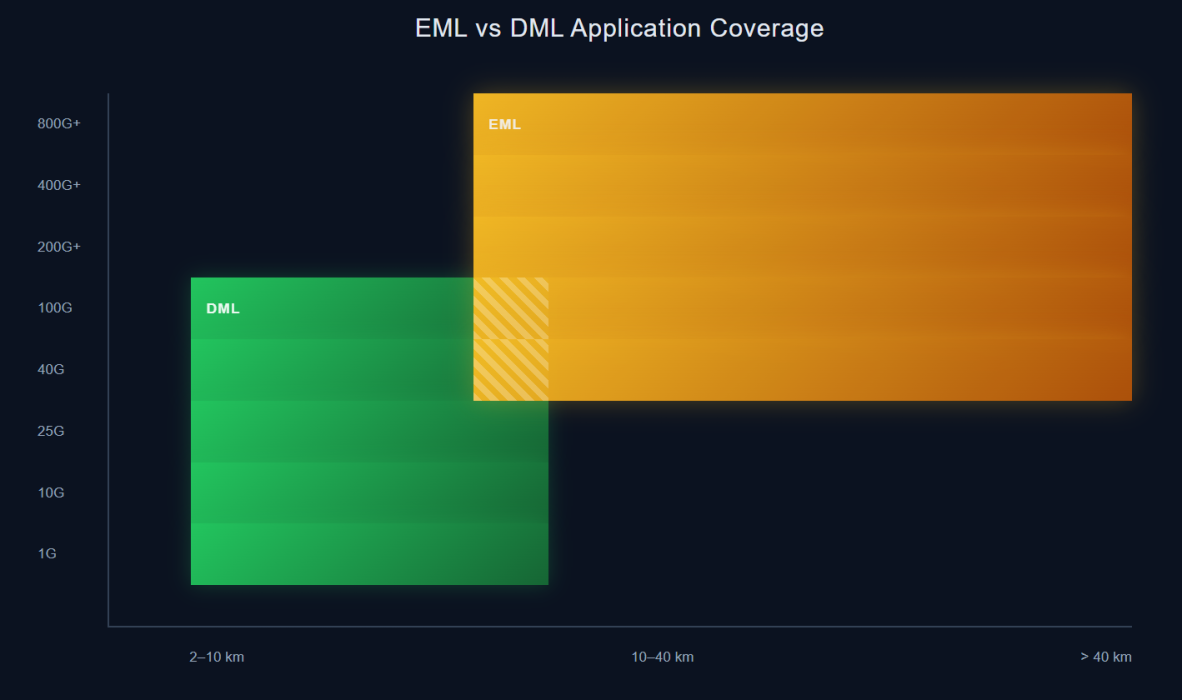
EML vs DML, on the other hand, is designed to perform well in harsh conditions. EML has better dispersion performance and better eye diagrams. It is simply more comfortable in environments with 40 km, 80 km, and higher rates. The problem is that EML is complex and expensive.
DML vs EML performance
| Comparison | DML | EML |
|---|---|---|
| Modulation method | Direct current modulation | External modulation |
| Chirp | More noticeable | Lower |
| Dispersion tolerance | Lower | Higher |
| Typical data rates | Medium to lower high speed | Higher speed preferred |
| Typical distance | Short to medium | Medium to long |
| Cost | Lower | Higher |
EML vs DML in Real Application Scenarios
In many data center environments, distances between devices are short, and budgets are constrained. You don’t need to be tolerant of a lot of dispersion over a 2km or 10km connection. In these environments, DML is a proven, predictable, cost-effective solution.
Typical Module Examples
-

Generic SFP-10G-LR Compatible 10GBASE-LR SFP+ 1310nm 10km Transceiver
-
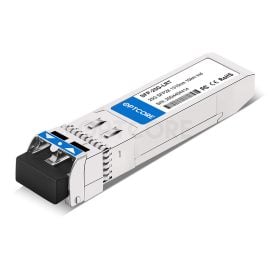
Generic Compatible 25GBASE-LR SFP28 1310nm 10km Industrial Transceiver
-
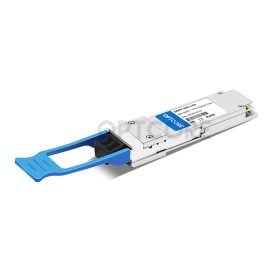
Generic Compatible 40G QSFP PSM LR4 10km Transceiver
-

Generic SFP-10G-BX10-U Compatible 10G SFP+ BiDi 1270nm-TX/1330nm-RX 10km Transceiver
In metro environments, the story is very different. The fiber distance is longer, the budgets are tighter, and the integrity of the signal is even more sensitive. This is where EML really shines. The lower chirp and better high-speed performance translate into better performance over longer distances.
Typical Module Examples
-
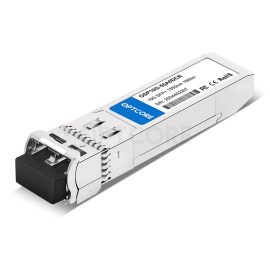
Generic SFP-10G-ZR100 Compatible 10GBASE-ZR100 SFP+ 1550nm 100km Transceiver
-
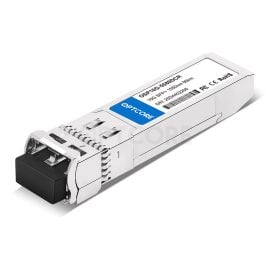
Generic SFP-10G-ZR Compatible 10GBASE-ZR SFP+ 1550nm 80km Transceiver
-

Generic Compatible 100GBASE-ER4 QSFP28 1310nm 40km Transceiver
-

Generic SFP-10G-BX80-D Compatible 10G SFP+ BiDi 1550nm-TX/1490nm-RX 80km Transceiver
How to Choose the Right Laser Diode Chip
| Scenario | Suggested Choice |
| Short link (≤10 km) | DML |
| Budget priority | DML |
| Long link (≥40 km) | EML |
| High speed | EML |
| High signal quality | EML |
If the link is short and the budget is an issue, DML is usually enough. If the distance is long or the speed is at the limits, EML provides more breathing room.
Summary
EML and DML are two different designs. DML keeps things neat and economical by letting the laser handle everything on its own. This works fine until the limits start to show themselves. With an EML, the work is divided into different parts. This may be more expensive, but it works better at speed and over distance.
So when it comes to EML vs DML, there is no universal winner. The right choice depends on what your link is asking the laser to do. In optical engineering, physics always wins. The trick is choosing the design that respects it.
FAQs
Q: Is EML always more advanced than DML?
Not necessarily. It is more suitable for high-speed and long-distance transmission, but in short-distance cases, it may not be the most cost-efficient option. In contrast, the DML technology is already mature in the market and can be a stable and reliable solution.
Read more
- How to Check If My SFP Is Single Mode or Multimode
- The Best PoE Ethernet Switch of 2026
- How to Protect Fiber Optic Cables – A Beginner’s Guide
