


 Optical Transceiver
 DAC/AOC Cable
 Fiber Cabling
 Networking
Blog, Optical Transceiver
Understanding 400G DR4 Optical Transceiver: A Complete Guide
Apr
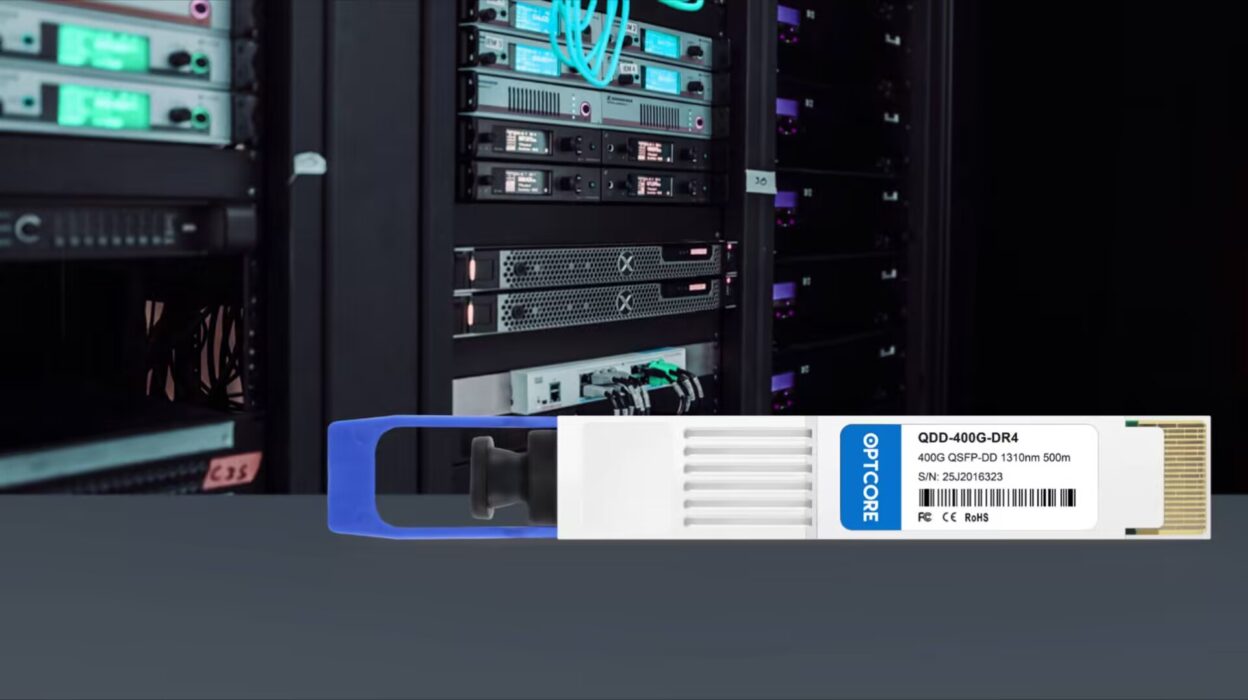
400G Ethernet has become a vital part of AI and big data operations. With the 400G speed-up, the optical interconnect infrastructure has seen significant developments, giving rise to several interface designs and form factors, such as QSFP-DD and OSFP. One such type is 400G DR4. 400G DR4 is commonly employed for high-speed communication links within a data center at short to medium distances. In practice, the DR4 type is commonly regarded as the primary option for achieving a balance between performance, economy, and energy efficiency.
Table of contents
What Is 400G DR4 and How It Works
400GBASE-DR4 is defined by IEEE 802.3bs, and its electrical interface is 400GAUI-8. Each lane is operating at about 53.125GBd PAM4 symbol rate. At the same time, the QSFP-DD MSA defines the module’s mechanical size, electrical interface, and power limits. The OIF CEI-56G-VSR-PAM4 standardizes the SerDes electrical performance.
The basic operating principle of 400G QSFP-DD DR4 optics is to achieve a combined bandwidth of 400Gbps through parallel optical transmission. Electrically speaking, the module first receives eight 50 Gbps PAM4 channels from the switch chip. Then converts them to four channels of 100Gbps optical signals. Each optical signal channel is separately sent over an individual optical fiber path, resulting in a total parallel structure of 4×100G.

The 400G DR4 QSFP-DD package expands the original QSFP interface to a double-density design, increasing electrical lanes from 4 to 8. This allows switches to deploy more high-bandwidth ports within limited front panel space, improving overall switching capacity. In high-density data center environments, this structural advantage is very clear. The design goal of DR4 is to optimize for typical connection distances inside data centers. Compared with SR4 or SR8, which are also parallel links, DR4 uses single-mode fiber and a 1310nm wavelength. This avoids issues such as modal dispersion that may occur in multimode fiber at high bandwidth, thus supporting longer transmission distances.
400G OSFP DR4
In addition to QSFP-DD, 400G DR4 can also use the OSFP form factor in some limited scenarios. The main differences between the two are more about mechanical structure and thermal design. OSFP DR4 is slightly larger than QSFP-DD and offers better heat dissipation. This kind of design is more common in 800G systems, allowing them to maintain stable performance under higher power or port density. In terms of interface and transmission principle, they are the same.
In real-world deployments, the choice usually depends on the switch platform’s interface design and overall thermal design. Also, backward compatibility is not a main focus. In the Ethernet ecosystem, QSFP-DD is still the mainstream, while OSFP is more often used in some HPC scenarios, and most OSFP modules are used in newly built networks.
Optical Connector of 400G QSFP-DD DR4
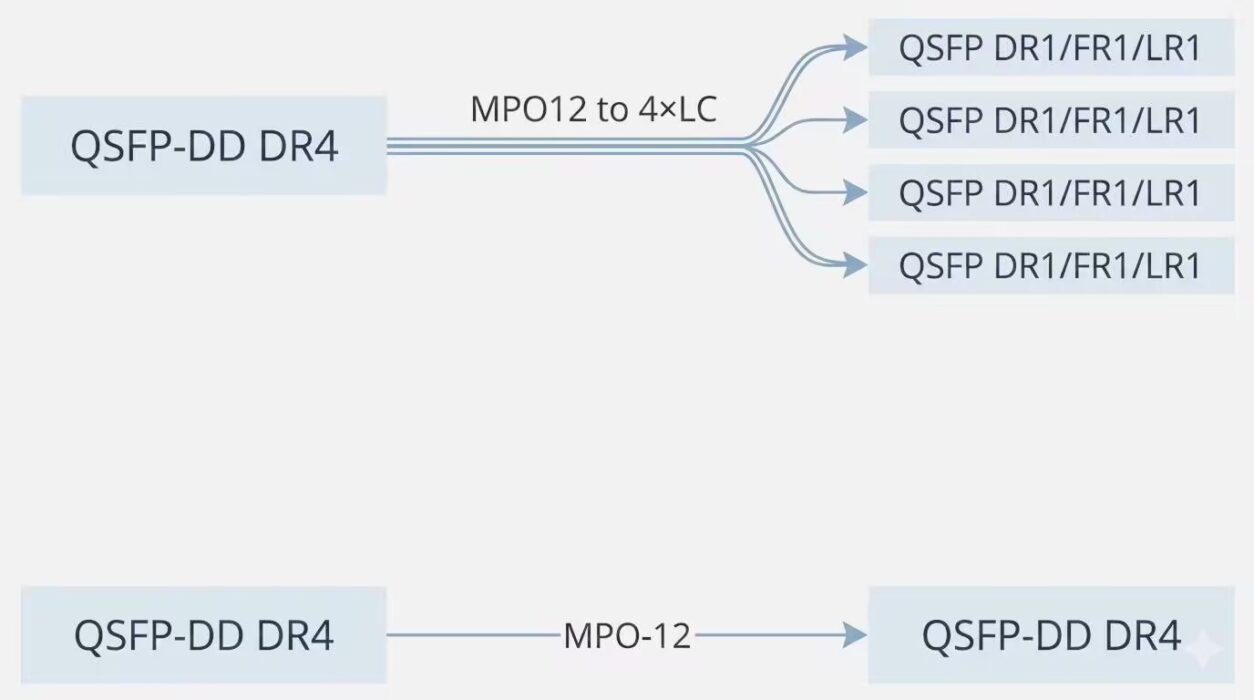
400G QSFP-DD DR4 uses an MPO-12 optical connector as the standard interface. And it usually works with OS2 single-mode fiber patch cords. In actual use, DR4 uses only 8 fibers in the MPO-12, with 4 for transmit and 4 for receive, leaving 4 unused. The cable typically appears as a yellow fiber with a green MPO/APC connector, a visual cue for high-speed single-mode links.
In addition, the parallel optics design enables the link breakout function. To accomplish this, it only takes an MPO-12-to-4×LC breakout cable to split one 400G DR4 port into four 100G connections, which can then be used to connect to 100G DR1, FR1, and LR1 modules. This characteristic carries significant practical significance when upgrading data centers. For instance, when the switch uses a 400G interface and the server or other hardware uses a 100G interface, such a connection is possible.
Key Features of 400G DR4 Optical Transceivers
- Engineering implementation of PAM4 and 1310nm
The use of PAM4 enables 400G over limited bandwidth, but it also reduces the signal-to-noise ratio, so higher link quality is required. The 1310nm wavelength in single-mode fiber offers lower dispersion and more stable transmission, helping offset these challenges. - Difference between parallel optics and WDM
DR4 uses 4 optical channels separately, but FR4/LR4 employs WDM technology that combines signals and sends them through only one fiber. Parallel optics do not require mux/demux components; the whole module will be simpler, more power-efficient, and lower-latency. But we will require additional fibers (8 fibers). - Optimal for a 500m single-mode connection
DR4 is optimized for specific distances. Within 500 meters, this option does not use WDM elements, which FR4 and LR4 use. Also, DR4 has an advantage in scalability of bandwidth compared to SR4. On leaf-spine and rack-to-rack links, DR4 will provide the same bandwidth at a lower price. - Balance between power consumption and port density
Without WDM components, DR4 modules usually consume less power than FR4/LR4. In a 32- or 64-port 400G switch, per-port power differences can significantly affect overall thermal design. The QSFP-DD form factor, combined with lower power, allows higher bandwidth density within a limited space. - DOM and operation visibility
Like other modules in our product line, DR4 supports Digital Optical Monitoring (DOM). DOM provides real-time information such as temperature, voltage, transmit power, and receive power. This monitoring helps reduce maintenance difficulty and allows faster troubleshooting of issues such as optical power loss or connection problems.
Applications of 400G DR4 in Modern Data Centers
In real deployments, 400G DR4 is mainly used for internal data center structural connections, such as links between Leaf and Spine switches. These are distances typically ranging from tens to hundreds of meters. In AI training clusters, GPU interconnect networks based on Ethernet or InfiniBand also widely use DR4 for connections. NVIDIA Spectrum-3 and Spectrum-4 series 400G Ethernet switches, as well as NVIDIA Quantum-2 (NDR 400G) InfiniBand switches, support 400G QSFP-DD interfaces. They can deploy DR4 modules in short-distance single-mode scenarios. On the server side, like NVIDIA ConnectX-6 or ConnectX-7 network cards with 400G ports, DR4 can also be used for direct connections to switches.
Moreover, depending on distance or cabling conditions, 400G interfaces other than those mentioned above may be considered. For relatively short distances with multimode cabling already installed, SR4 may be used; for longer distances, FR4/LR4 interfaces are preferred. Our products offer compatible accessories for these devices.
-
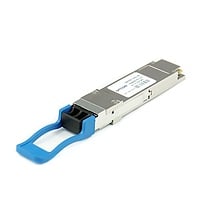
Generic Compatible 400G FR4 QSFP-DD 1310nm 2km LC Transceiver
US$ 459.00 (Excl. VAT) -
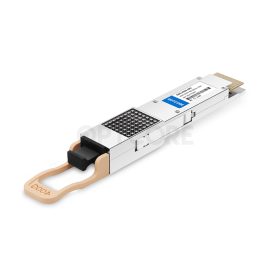
Generic Compatible 400G DR4 QSFP-DD 1310nm 500m MTP/MPO-12 Transceiver
US$ 429.00 (Excl. VAT) -
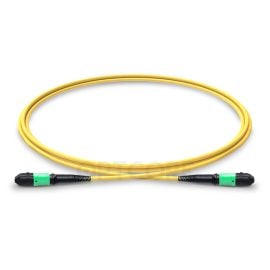
Single Mode OS2 MPO to MPO Trunk Cable, 12 Fiber, Female, Type B, LSZH
Price range: US$ 22.00 through US$ 104.00 (Excl. VAT) -
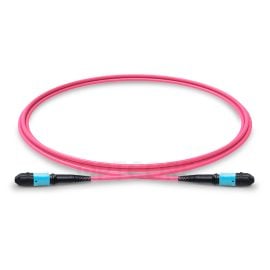
Multimode OM4 MPO to MPO Fiber Trunk Cable, 12 Fiber, Female, Type B, LSZH
Price range: US$ 21.10 through US$ 283.50 (Excl. VAT)

FAQ
# How to choose between 400G DR4 and 400G SR4 in practice?
The key depends on your transmission medium and cabling environment. If single-mode fiber is already in place or higher scalability is required, DR4 is more suitable. If the distance is short and multimode cabling is already deployed, SR4 may have cost advantages.
Conclusion
Due to the good performance and well-balanced architecture, 400G DR4 is one of the essential elements of modern-day data centers. In many cases, the connections between devices will benefit greatly from using 400G DR4 as an optimal solution. Moreover, the features of DR4 make it highly scalable and suitable for further development.
Read more
- 400G SR4 vs DR4 vs FR4 vs LR4: What Are the Differences and How to Choose?
- MPO-8, MPO-12, or MPO-24? Choosing the Right Backbone for Your 400G Infrastructure
- Introducing OPTCORE Single Lambda 100G QSFP28 Transceiver: A Comprehensive Guide
