


 Optical Transceiver
 DAC/AOC Cable
 Fiber Cabling
 Networking
Blog
Understanding Terabit Ethernet: 100G, 200G, 400G, and 800G
Mar
What is Terabit Ethernet?
Terabit Ethernet refers to the stage where Ethernet speeds move into the terabit range. Today, common data rates include 100G, 200G, 400G, and 800G. These speeds build the foundation for future 1Tbps networks.
From a standards perspective, Terabit Ethernet comes from the ongoing evolution of IEEE 802.3. As data center traffic continues to grow, traditional bandwidth cannot keep up with communication between servers, storage systems, and compute nodes. This drives the adoption of higher-speed Ethernet in modern networks.
Each upgrade brings improvements to physical-layer technologies, including encoding methods, modulation schemes, and optical modules. Once speeds move beyond 100G, the changes become more noticeable. Nowadays, the technology of multi-lane transmission and PAM4 modulation is widely adopted, and it has laid the technical foundation for Terabit Ethernet.
Simply put, Terabit Ethernet refers to the next generation of high-speed Ethernet technology. It indicates that the next generation of data center networks will be of ultra-high bandwidth and performance.
Evolution of Modern Networks
The evolution of Ethernet has been incremental, with each step responding to the needs of the network. The original Ethernet ran at 10 Mbps, with initial focus on basic connectivity. As the enterprise network grew, 100 Mbps, 1 GbE, and similar speeds became the norm, with an emphasis on stability.
When cloud computing and virtualization became mainstream, the amount of data per server increased quickly. The network started to impact overall system performance. This shift pushed 40G and 100G Ethernet into data center core networks.
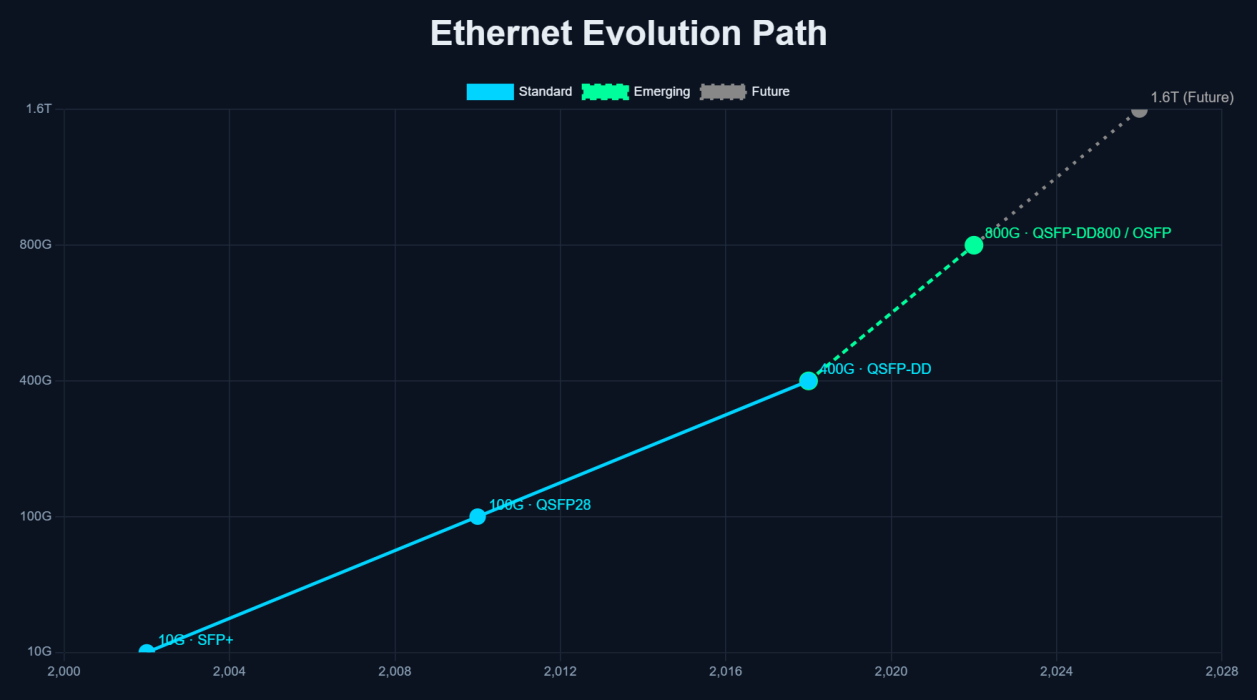
Today, 100G is ubiquitous in the data center. 200G and 400G are growing rapidly, and 800G is starting to appear in the real world. Network designs have also changed. Three-tier network designs are being replaced by Leaf-Spine designs. The demand for bandwidth is always on the rise, with greater emphasis on latency and power efficiency. The cost per bit is always decreasing. Terabit Ethernet is a logical next step in this progression.
What Makes Terabit Ethernet Different from Traditional GbE
Changes in Transmission Architecture
In 1G/10G Ethernet, single-lane high-speed transmission is mostly used with NRZ signaling. As Ethernet speeds exceeded 100G, single-lane high-speed transmission faced challenges. The solution is to use multi-lane high-speed transmission with more efficient signaling. For example, 100G Ethernet can be achieved with 4x25G lanes, while 400G Ethernet can be achieved with 8x50G or 4x100G lanes. The goal is to divide the total data across multiple lanes, thereby reducing the load on each lane.
At the same time, interface styles have changed. SFP+ has been followed by QSFP28, then by QSFP-DD and OSFP. These newer form factors support more lanes, higher bandwidth, and increased power requirements.
PAM4 (Pulse Amplitude Modulation 4)
PAM4 is one of the key technologies behind high-speed Ethernet. Traditional NRZ carries 1 bit per signal cycle. PAM4 carries 2 bits per cycle. This effectively doubles the data rate without increasing the signal bandwidth.
Because of this advantage, PAM4 is widely used in 200G, 400G, and 800G optical modules. Typical implementations include 50G and 100G PAM4 lanes. PAM4 also presents new challenges. It requires improved signal processing, stronger forward error correction (FEC), and more advanced DSP chips. All these requirements add to the power and cost of high-speed optical modules.
Impact on Emerging Technologies
AI and Data Centers
Terabit Ethernet has a direct impact on AI systems. This is because AI models require continuous data interchange between GPUs, especially in synchronizing parameters and updating models. In NVIDIA systems, network bandwidth has a clear limit on the efficiency of AI models. Increasing network speeds reduces waiting times between GPUs, thus increasing utilization efficiency.
In 400G and 800G Ethernet, data is transferred at faster rates, thus reducing the time required for AI models. This enables efficient use of these models, especially for large ones. High-speed networks are also required for real-time AI inference, where low latency is crucial.
Internet of Things and Edge Computing
The number of connected devices is constantly increasing, ranging from industrial sensors to smart home applications. Terabit Ethernet offers the necessary bandwidth to aggregate the data and transport it across the network. It enables communication between edge nodes and centralized data centers. In edge computing environments such as smart factories and smart cities, fast and stable networks improve response time and reduce congestion. This makes it easier to scale large deployments.
Big Data and Real-Time Analytics
Data platforms rely on fast data movement between storage, compute, and network layers. As datasets grow, network performance becomes a key factor. Terabit Ethernet speeds up data transfer between nodes. This makes real-time analytics more practical. Applications such as financial risk control, recommendation systems, and log analysis all benefit from faster data movement.
New Application Scenarios
More bandwidth means we can create new types of applications. For smart cities, we need data from cameras and sensors at all times. With faster networks, we can now achieve higher video resolutions.
For autonomous driving, we have various applications that communicate with different vehicles, edge, and cloud environments. The performance of the network has a direct effect on the decision-making process. For virtual reality, we need high-quality data streams, and with the help of high-speed Ethernet, we can have better interaction with the data.
100G, 200G, 400G, and 800G Standards
The speeds are defined by the IEEE 802.3 specification and are associated with the physical design and optical modules.
100G Ethernet was the initial high-speed Ethernet specification to be deployed at scale. It includes 100GBASE-SR4 and LR4 designs for different distances and cable types, usually implemented with 4×25 G NRZ or single-lane PAM4. It is widely deployed in the access and aggregation layers of data centers. 200G Ethernet is an extension of the 100G Ethernet and focuses on increased port density. It is commonly implemented using 4×50G PAM4. This makes it suitable for high-density switching environments.
400G Ethernet is currently one of the fastest-growing standards. Common types include DR4, FR4, and LR4, each designed for different transmission distances. It uses 8×50G or 4×100G PAM4. In real deployments, 400G is often used for spine layers and data center interconnects. 800G Ethernet represents the latest Ethernet speed technology. It normally consists of 8x 100G PAM4, and it’s mainly intended for large-scale data centers and artificial intelligence applications. At this level, power consumption, cooling, and signal integrity are the major challenges in the design process.
These speeds are related to the following optical module form factors:
- 100G – QSFP28
- 200G – QSFP56
- 400G – QSFP-DD / OSFP
- 800G – QSFP-DD800 / OSFP
-

Generic Compatible 100G QSFP28 SR4 850nm 100m Transceiver
US$ 29.90 (Excl. VAT) -
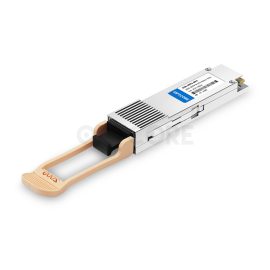
Generic QSFP56-SR4-200G Compatible 200GBASE-SR4 QSFP56 850nm 100m Transceiver
US$ 289.00 (Excl. VAT) -
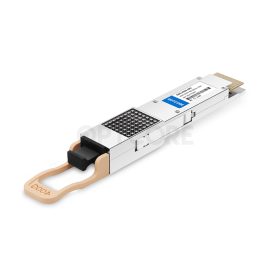
Generic QSFPDD-400G-SR8 Compatible 400GBASE-SR8 QSFP-DD 850nm 100m Transceiver
US$ 139.00 (Excl. VAT) -
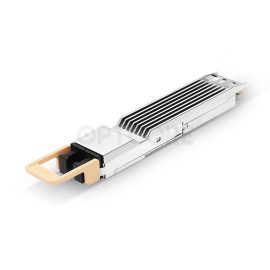
Generic OSFP-800G-SR8 Compatible 800G 2xSR4/SR8 OSFP Finned Top 850nm 100m Dual MPO-12/APC Transceiver
US$ 599.00 (Excl. VAT)
In reality, it is not only the switch that has to be upgraded in terms of speed, but also the optical modules and cabling system.
Conclusion
Terabit Ethernet is pushing networks toward higher bandwidth and higher density. Switch port speeds continue to increase, and network architectures keep evolving to support larger and more complex workloads. As computing demand grows, especially in AI and data-intensive applications, high-speed Ethernet will continue to develop. Terabit Ethernet is becoming a core foundation for modern networks and will support the next stage of global connectivity.
Read more
- 100GBASE-SR4 vs. 100GBASE-BiDi SR vs. 100GBASE-SR10: What is the difference?
- 100G QSFP28 Transceiver Solution
- Hyperscale Data Center Driving 400G Transceiver Demand
- Understanding CS Connector for Fiber Patch Cable: A Beginner Guide
