


 Optical Transceiver
 DAC/AOC Cable
 Fiber Cabling
 Networking
Blog, Networking Device
NVIDIA A100 vs H100 vs L40S vs A6000: A Detailed Comparison
Mar
With the rapid development of AI technology and LLMs, the need for computing power is growing rapidly. Many people have noticed that older GPUs are no longer sufficient, especially for large-scale training workloads. NVIDIA has been continuously updating its data center GPU lineup. The H100 is currently one of its flagship products. H100 vs A100, it brings clear improvements in architecture, memory, and AI performance. One key feature is the Transformer Engine, which is designed to accelerate LLM training and inference.
At the same time, AI is no longer limited to large enterprises. More small teams and individual developers are now deploying models locally. This raises a practical question: should you choose A100 or H100, or opt for cost-effective options like L40S or A6000? The article will help you understand the difference and make a decision.
Table of contents
Overview of These GPUs
NVIDIA H100
The H100 was released in 2022 and is based on the Hopper architecture. It is intended for large-scale AI training. H100 vs A100, the largest advantage of the H100 is the Transformer Engine, which supports dynamic switching between FP8 and FP16. This improves performance while keeping accuracy under control. It also uses HBM3 memory and higher-bandwidth NVLink, which makes it very strong in multi-GPU environments. Overall, H100 is built for the LLM era and targets high-end AI clusters.
NVIDIA A100
The NVIDIA A100 was announced in 2020. It is based on the Ampere architecture and is still one of the most popular choices for data centers. It supports Tensor Cores and MIG (Multi-Instance GPU). This allows a single GPU to be split into multiple instances. This is very useful in cloud environments. With HBM2e memory and a mature ecosystem, A100 remains a reliable choice. Even though it is not as powerful as H100, its stability and wide adoption make it a solid option.
NVIDIA L40S
The L40S was released in 2023 and is based on the Ada Lovelace architecture. Its positioning is different from A100 and H100. It is more focused on inference, graphics, and general AI workloads, and it also supports FP8 and Tensor Cores, enabling it to handle mid-sized models and making it more cost-effective, which means it can be used for inference services or training.
NVIDIA RTX A6000
The A6000 was announced in 2020. This is a workstation card based on the Ampere architecture. This is intended for local deployment, which means development, testing, or smaller-scale AI work. This cannot be used for training at a data center scale, but it has more flexibility and lower deployment costs. This is often used by developers.
A100 vs H100
In several key areas, A100 vs H100, H100 is in a better position. The first area is architecture. The Hopper architecture is more optimized for AI-related tasks, particularly with the Transformer Engine. While A100 is also suitable for AI-related tasks, it is more generalized and not specifically for LLMs. Next is memory and bandwidth. H100 uses HBM3, which provides higher bandwidth. This becomes very important when training large models. NVLink is also improved, which allows faster communication between GPUs. This has a big impact on distributed training.
A100, however, has the advantage of maturity. Many systems, frameworks, and cloud platforms are already optimized for it. If your workload is already stable on A100, upgrading to H100 may not be necessary right away.
| Model | Architecture | VRAM | Memory Bandwidth | FP16 / BF16 | NVLink | Power |
|---|---|---|---|---|---|---|
| H100 | Hopper | 80GB HBM3 | ~3 TB/s | Very high (FP8 + Transformer Engine) | Yes (higher bandwidth) | ~700W |
| A100 | Ampere | 40GB / 80GB HBM2e | ~1.6 TB/s | High | Yes | ~400W |
A100 / H100 vs L40S / A6000
A100 and H100 are typical data center training GPUs, while L40S and A6000 are more flexible and easier to deploy. The first group is mainly used for large-scale training in servers or clusters. The second group is more suitable for inference, development, or mid-sized workloads.
In real-world use, the difference is quite clear. A100 and H100 are used to train models, while L40S and A6000 are often used to run models. If your goal is local inference or testing, there is no need to use A100 or H100. L40S or A6000 is usually enough. But once you move to large-scale training or multi-node setups, data center GPUs become necessary.
| Model | Architecture | VRAM | Memory Bandwidth | FP16 / BF16 | NVLink | Power |
|---|---|---|---|---|---|---|
| L40S | Ada Lovelace | 48GB GDDR6 | ~864 GB/s | Medium-high (FP8 supported) | No | ~350W |
| A6000 | Ampere | 48GB GDDR6 | ~768 GB/s | Medium | No | ~300W |
Real-World Deployment Scenarios
Large-scale AI training (data center)
These are the most common deployment scenarios for the H100 and A100. In these environments, multiple servers are connected in a cluster for training. In these environments, GPUs are just one aspect of the system; in fact, the real limiting factor is often data transfer. GPUs talk to each other using NVLink within a server; however, when it comes to multiple servers, network connections become a critical aspect.
Mid-scale training and inference services
However, many companies do not start with H100 clusters. They might start with L40S or A6000 for inference or mid-level training. This is more about cost, flexibility, and power efficiency. For a system such as a recommendation system or an AI API, these GPUs might already be sufficient.
Local Development and Workstation
For small development teams or individual developers, the preferred option is to use the A6000. This can be set up in a workstation. This is easier and does not involve setting up a data center.
AI Cluster Networking (Critical Layer)
For a multi-node training system, the next important component is the network. The GPUs in the system, such as the A100 vs H100, communicate internally using PCIe or NVLink. To connect different servers in the system, we ofen use high-speed NICs such as the NVIDIA ConnectX. These connect to the switch via IB or high-speed Ethernet. They use QSFP-56, QSFP-112, and OSFP interfaces. This is when optical modules come into play. They can transmit data at 100G, 200G, 400G, and even 800G. OPTCORE specializes in optical modules and cabling for NVIDIA-based solutions.
-

Generic Compatible 100G QSFP28 SR4 850nm 100m Transceiver
US$ 29.90 (Excl. VAT) -
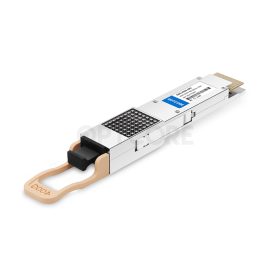
Generic QSFPDD-400G-SR8 Compatible 400GBASE-SR8 QSFP-DD 850nm 100m Transceiver
US$ 139.00 (Excl. VAT) -
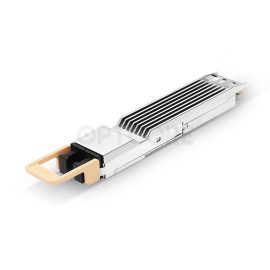
Generic OSFP-800G-SR8 Compatible 800G 2xSR4/SR8 OSFP Finned Top 850nm 100m Dual MPO-12/APC Transceiver
US$ 599.00 (Excl. VAT) -
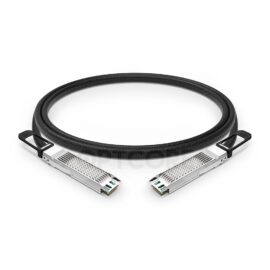
0.5~2m Generic OSFP-800G-DAC Compatible 800G OSFP Finned Top DAC Cable
Price range: US$ 99.00 through US$ 159.00 (Excl. VAT)
FAQs
# 1 Do I really need H100?
Not necessarily. If you are working on very large models, H100 makes sense. However, A100, L40S, or even A6000 might be enough depending on the scale and budget of the users.
#2 Is L40S enough for LLM?
For many inference workloads, yes. It does work well. However, for a very large model, an A100 or an H100 is still needed.
Conclusion
A100 vs H100, many people assume that H100 is always the best choice. In reality, it depends on your use case. If you’re working with a large-scale training, the most direct solution will be the H100. For a small workload, especially an inference workload, the L40S or A6000 might be a better solution, depending on cost and deployment considerations. The A100, as a balance between performance and maturity, will sit in the middle.
Read more
- What Is 100 Gigabit Ethernet? A Beginner’s Guide
- The 10 Best Home Network Switch for 2025
- The Best Ethernet Cable for Xbox in 2025
