


 Optical Transceiver
 DAC/AOC Cable
 Fiber Cabling
 Networking
Blog, Network Cabling, Optical Networking
25GBASE-T vs. 25G SFP28 Fiber: The Truth About 25GbE Copper Networking

Apr
We already know that 25G is different from 1G and even 10G, and it has been classified as high-speed networking. The 1G-T copper connection that was widely used in 1G now seems to be marginal and less visible in 25G. Most engineers tend to use optical modules for cabling and planning. But why are there still some vendors providing 25GBASE-T, and why is it still deployed by some people? What exactly is the difference between 25GBASE-T and 25G SFP28 fiber?
Table of contents
What is 25GBASE-T and 25G SFP28 fiber?
25GBASE-T: A 25GbE Ethernet standard based on copper cable (twisted pair), usually using the RJ45 interface. It relies on multi-level modulation (such as PAM16) and complex digital signal processing to transmit high-speed data over copper.
SFP28 Fiber: A 25GbE solution based on optical fiber, using SFP28 optical modules, transmitting data through optical signals.
Connection method of them
25GBASE-T continues the traditional Ethernet interface, the port is a standard RJ45 port, and the appearance is almost the same as 1G/10G ports. It usually uses Cat6a or Cat8 copper cables, and both ends are directly plugged into switches or NICs. The cabling form is similar to traditional Ethernet. But at 25G speed, this connection actually requires much higher cable quality, shielding, and crosstalk control than 1G/10G.
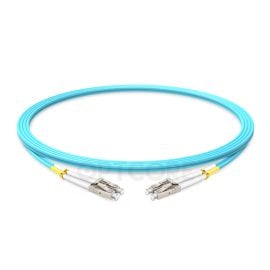
Device → 25GBASE-T → Cat6a/Cat8 → 25GBASE-T → DeviceSFP28 fiber uses a modular interface design. The front of the module is usually a dual LC fiber interface, connected to the other device through fiber patch cords. According to single-mode or multi-mode modules, different patch cords are used, such as OM3 or OS2. From the appearance, the ports are smaller and denser, allowing more ports on one panel. The direct transmission of optical signals makes power consumption and latency more stable and better compared with 25GBASE-T.
Device → SFP28 → Fiber → SFP28 → Device-
LC-LC 9/125 OS2 Singlemode LSZH Duplex Fiber Patch Cable
Price range: US$ 2.40 through US$ 27.50 (Excl. VAT) -
Cat6A Snagless Shielded (SFTP) Ethernet Network Patch Cable, PVC, Blue
Price range: US$ 1.49 through US$ 22.35 (Excl. VAT) -
LC-LC 10G OM3 Multimode Duplex LSZH Fiber Optic Patch Cable
Price range: US$ 2.80 through US$ 40.70 (Excl. VAT) -

Cat8 Snagless Shielded (SFTP) 25G/40GBase-T Ethernet Network Patch Cable, PVC, Black
Price range: US$ 2.25 through US$ 28.80 (Excl. VAT)

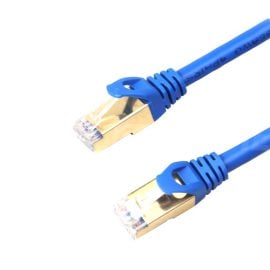
25GBASE-T vs. SFP28 Fiber: Differences between them
When actually implementing the two technologies, 25GBASE-T vs. SFP28 Fiber differ from each other in many ways, including bandwidth utilization, power usage, latency, and connection complexity. The following table may help you compare the two technologies.
| 25GBASE-T | SFP28 Fiber | |
|---|---|---|
| Medium | Copper (twisted pair) | Optical fiber |
| Connector | RJ45 | SFP28 + LC |
| Signaling | PAM16 + DSP | Optical signaling |
| Latency | Higher | Lower |
| Power | 4W+ | ~1W |
| Distance | ≤30m | 100m–40km |
| Heat | High | Low |
| Ecosystem | Limited | Mature |
Why often choose SFP28 Fiber and why 25GBASE-T nearly Took Off
Many people think that after 10GbE, there is almost no reason to choose copper. In most data center scenarios, this is true. The reasons mainly focus on power consumption, latency, and the ecosystem. But this conclusion is not absolute.
-

Generic Compatible 25G SFP28 ER 1310nm 40km Transceiver
US$ 139.00 (Excl. VAT) -
Generic Compatible 25G SFP28 LR 1310nm 10km Transceiver
US$ 25.00 (Excl. VAT) -

Generic Compatible 25G SFP28 SR 850nm 100m Transceiver
US$ 15.00 (Excl. VAT) -
Generic Compatible 25G SFP28 ER 1310nm 30km Transceiver
US$ 129.90 (Excl. VAT)
Why data centers prefer SFP28 Fiber
#1 Power consumption
To transmit 25Gbps signals over copper, 25GBASE-T needs PAM16 modulation, echo cancellation, crosstalk suppression, and forward error correction (FEC). These are processed by DSP inside the PHY chip, and DSP itself consumes a lot of power. In real products, a 25GBASE-T port typically consumes 4W or more, while SFP28 optical modules typically consume less than 1W. In a 48-port or 64-port switch, this means tens or even over a hundred watts of extra power and higher cooling requirements. This is also why many high-end switches do not provide 25GBASE-T versions.
#2 Latency
25GBASE-T needs multiple layers of signal processing, such as encoding, equalization, and error correction, and latency comes from the complexity of the processing chain. Each step adds a delay. While 25GBASE-T vs. SFP28, SFP28 optical modules have a simpler physical layer, and latency is close to the line rate. In AI training, distributed computing, and financial trading, many small packets are exchanged frequently, and latency will be amplified, finally affecting system performance. Therefore, SFP28 Fiber is more often chosen in high-speed networks.
#2 Ecosystem
The ecosystem determines whether a technology can be widely used. So far, SFP28 has become the de facto standard for 25G, from server NICs, switches, to the optical module supply chain; everything is mature. You can easily find compatible devices, replacements, and interoperability between vendors. In comparison, the ecosystem of 25GBASE-T is weak. There are fewer switch models, limited NIC options, and almost no pluggable modules. This brings a real problem: if you deploy this type, future expansion, maintenance, and replacement may become difficult.
Why 25GBASE-T still exists
In actual procurement and deployment, it is hard to see large-scale use cases, especially in data centers. But from the standard perspective, 25GBASE-T is defined and still exists. 25GBASE-T is technically feasible, but due to power, packaging, and ecosystem constraints, it lacks scale advantages and has not become mainstream.
Even so, 25GBASE-T is not completely useless. In environments with existing copper cabling, such as enterprise rooms or access networks, most setups are still 1G or 10G and do not plan to upgrade soon, so re-laying fiber is costly. In this case, continuing to use RJ45 is more practical. Also, for short distances such as inside a rack or between adjacent racks, if latency and power are not sensitive, copper can still work. 25GBASE-T vs. SFP28, 25GBASE-T is more of a compatibility solution for existing environments, while SFP28 Fiber is designed for new architectures and future scaling.
Make the appropriate selection for yourself
- In case of data centers/AI Clusters where there are high-speed requirements and scalability, SFP28 Fiber is to be preferred. This is due to the high density, continuous loading requirement, or low latency sensitivity, which would be necessary, and fiber will fit well if any of these conditions hold.
- Where you already have complete copper wiring and short distances, you can use 25GBASE-T. This is because you can avoid the cost of re-wiring, accepting the higher power consumption and latency requirements.
- In case future upgrades such as 100G or 400G become necessary, immediately select fiber. This is because scaling up beyond 25G over copper is nearly impossible.
- Where you have uncertainty regarding compatibility and maintenance issues, you should choose SFP28.
FAQ
Q: Why is 25GBASE-T better than DAC?
Both use short-length copper cables. The key benefit of 25GBASE-T is its compatibility with RJ45 cable standards. In terms of power saving, low latency, and stability, however, DAC performs much better.
Conclusion
In most cases, compared with 25GBASE-T and SFP28 Fiber, an SFP28 Fiber combination is recommended. When talk about 25GBASE-T vs. 25G SFP28 Fiber, SFP28 Fiber ofen has clear advantages in power, latency, ecosystem, and future scalability. The demand for 25GBASE-T is low across the market, and it is more of a compatibility solution for specific scenarios than a mainstream choice. But based on your real needs, if there are suitable scenarios, 25GBASE-T can still be used as an alternative.
Read more
- SFP28 vs SFP+ Transceiver, What is the Difference?
- What Is DSFP? A Complete Guide
- SFP+, SFP28, QSFP+, QSFP28, QSFP56, QSFP-DD, QSFP112 vs OSFP, What are the differences?
